Oak Wilt in Your Neighborhood? How to Protect Your Trees Before It Spreads
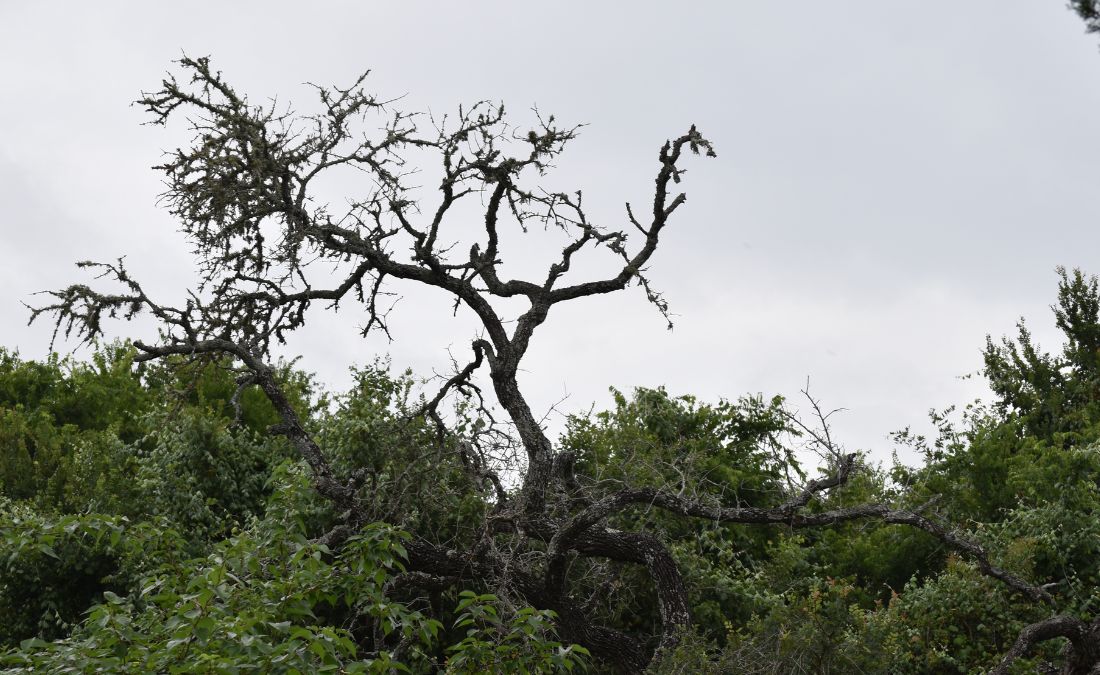
When oak wilt is confirmed on neighboring properties, nearby oaks face higher risk. Learn practical prevention steps homeowners in Davenport can take.
Your neighbor’s oak was just removed. Not long ago, it looked like a healthy tree, and now, you’re staring at a stump, wondering if your own oaks could be next. If you’re searching for oak wilt prevention options, you’re already ahead of most homeowners. But it’s important to understand where the real risk comes from.
Oak wilt doesn’t spread overnight, but once it’s confirmed nearby, the risk to surrounding oaks increases – especially in Quad Cities neighborhoods with mature trees growing close together. While insects can spread the disease in some cases, the more serious threat is underground, where connected root systems can allow the fungus to move unseen from one property to the next. The good news is that preventive steps can significantly reduce that risk – if they’re taken before symptoms appear on your side of the property line.
Key Takeaways
- Oak wilt spreads underground through root grafts between trees within 50 feet of each other; this is how most urban infections occur.
- Fungicide injections can keep a healthy tree alive, but they don’t stop the disease from traveling through connected roots.
- Trenching (cutting root connections) is the only way to physically block underground transmission.
- Trench barriers must be installed before infected trees are removed to prevent the fungus from being pulled into healthy root systems.
- Your neighbor’s cooperation isn’t necessarily required – you can protect your trees by installing a trench barrier on your property line and treating high-value oaks with fungicide.
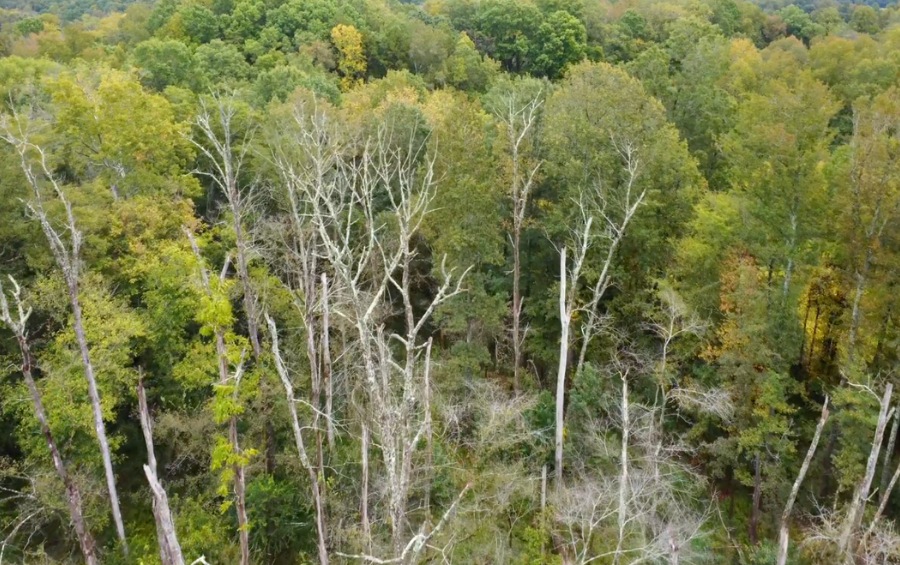
Oak wilt spreads outward from infected trees through connected root systems, killing oaks in an expanding pocket pattern visible from above.
How Does Oak Wilt Spread from My Neighbor’s Tree to Mine?
Oak wilt spreads underground through root grafts – natural connections that form when tree roots grow close together and fuse. Approximately 90% of new oak wilt infections occur through these underground pathways, not through beetle transmission above ground.
Oaks growing within 50 feet of each other commonly share connected root systems, though the actual risk depends on species, spacing, and how long the infection has been active:
- Most urban spread happens within 30 feet of an infected tree
- Red oaks graft with red oaks; white oaks graft with white oaks
- The fungus can travel through roots for 1–6 years before symptoms appear above ground
- Multiple oaks in a row create a connected network with higher transmission risk
Thus, in Quad Cities neighborhoods, where residential lots often place mature oaks just 20 to 40 feet apart, root graft connectivity is especially high. By the time you notice symptoms on a neighbor’s tree, the fungus may already be moving toward yours.
How Can You Tell if Your Oak Tree Is at Risk from a Neighbor’s Infection?
Your oak tree is at risk if it’s within 50 feet of an infected tree and shares the same species group. Not sure where you stand? These factors will help you assess your situation.
What Puts Your Oak at High Risk?
Your tree faces elevated risk if any of these conditions apply:
- Your oak is within 50 feet of an infected tree
- Your oak belongs to the same species group (red oak group or white oak group) as the infected tree
- Multiple oaks stand between your tree and the infected tree, creating a connected root network
- You’ve noticed leaf drop, browning, or canopy thinning on your tree
When Is the Oak Wilt Risk Lower?
Some situations reduce the likelihood of root graft transmission:
- Your oak is more than 50 feet from any infected tree
- Your oak belongs to a different species group than the infected tree
- No intermediate oaks connect your tree to the infection source
That said, proximity matters most – and in the Quad Cities, the disease is closer than many homeowners realize. Oak wilt is already active in the area, with confirmed cases in at least East Davenport’s Pineacre and Crestline Drive areas. Which means if you’re in or near a neighborhood with known infections, assume elevated risk for any oaks within 50 feet of each other.
How Can You Protect Your Oaks from a Neighbor’s Oak Wilt?
The best options for protecting your oaks are trenching to block root transmission and fungicide injections to protect individual high-value trees. Understanding what each method does – and doesn’t do – is critical.
How Does Root Trenching Stop Oak Wilt Spread?
Trenching physically severs root grafts, cutting off the underground pathway the fungus uses to travel between trees. The process uses a vibratory plow to cut a trench at least 5 feet deep – below the root zone where grafts form.
Placement is critical, and the logic isn’t always intuitive. Because the fungus travels to neighboring trees within the 50-foot radius, the trenches must be dug at least 100 feet beyond the last symptomatic tree in an effort to get ahead of the spread. In this way, it’s like a firebreak. You don’t dig a firebreak where the fire already is – you dig it ahead of where it’s spreading. The trench needs to be far enough out to sever roots the fungus hasn’t reached yet.
What makes trenching effective:
- It’s the only proven method to stop underground transmission
- Once installed, it permanently breaks the root connection
- It protects all trees on your side of the barrier
But all of that depends on getting the sequence right. The trench must be installed before removing the infected tree – cutting down a diseased oak first can actually accelerate fungus movement, pulling it through the remaining root system into connected healthy trees.
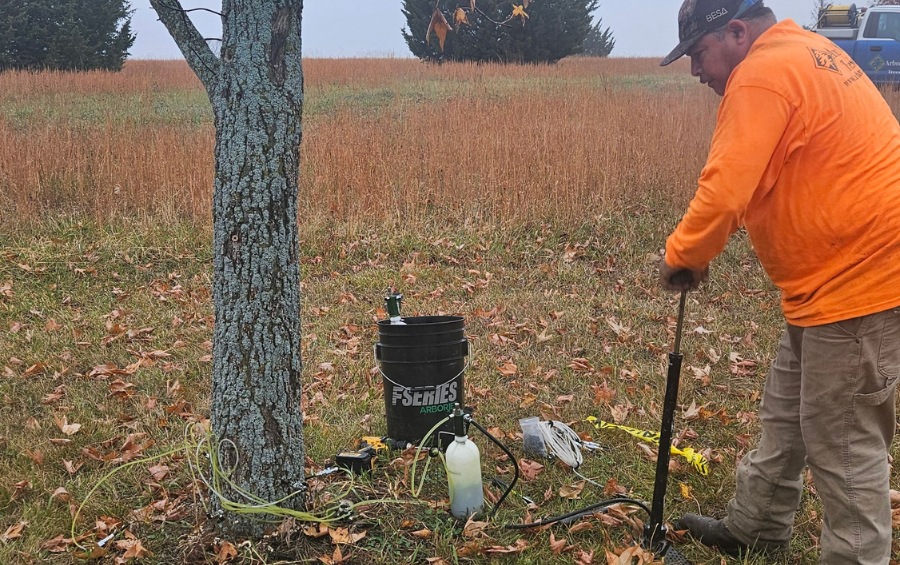
A technician performs a preventive fungicide injection, delivering propiconazole directly into the oak’s vascular system to protect against oak wilt infection.
Can Fungicide Injections Protect Your Oak Trees?
Yes, fungicide injections can protect your trees – but with important limitations. Fungicide injections work by delivering a chemical called propiconazole (commonly sold as Alamo) directly into the tree’s vascular system, where it suppresses the fungus and prevents symptoms from developing. When applied to healthy trees that haven’t yet shown symptoms, survival rates reach 85–90%.
But there are caveats:
- It only protects the tree it’s injected into
- It requires reapplication every 18-24 months
- It can’t save a tree that’s already showing symptoms
That’s why fungicide works best as a complement to trenching, not a replacement. Use it to protect high-value trees you want to save, especially those inside an established trench barrier or in situations where trenching isn’t physically possible.
PRO TIP: When multiple oaks line up between properties, treat them all – not just the one closest to the infection. The fungus can hopscotch through each connected root system, so protecting only the first tree in line leaves the rest exposed.
When Should You Schedule Oak Wilt Prevention Treatments?
Trenching and fungicide follow different timelines. Trenching depends on ground conditions – the soil needs to be workable, which typically means late fall before freeze or after spring thaw. Fungicide injections happen during the growing season when leaves are present, and the tree is actively moving water through its vascular system.
For Quad Cities homeowners, late winter is the ideal time to get the process started. Not because the work happens then, but because it’s your window to line things up before spring:
- Schedule an arborist assessment to evaluate which trees are at risk
- Get utility clearance to mark utility lines before any trenching
- Get on the calendar before spring demand picks up
By the time the ground thaws in March or April, you’ll be ready to move quickly rather than starting from scratch.
TIMING NOTE: Trenching and pruning follow different rules. The October 15 – March 1 pruning window exists to avoid beetle transmission through fresh wounds. Trenching has no seasonal restriction; it depends only on ground conditions. Once the soil thaws in spring, trenching can proceed even after the safe pruning window closes.
Frequently Asked Questions About Oak Wilt Prevention and Neighbor Trees
Can I tell if my oak has root grafts with a neighbor’s tree?
There’s no visible way to confirm root grafts without excavation. Arborists simply assume grafts exist when oaks of the same species group grow within 50 feet of each other – and plan protection accordingly.
How quickly does oak wilt kill a tree once symptoms appear?
Red oaks can die within weeks of showing symptoms – sometimes in as little as a month. White oaks decline more slowly, often over several years, giving more time to respond.
Will oak wilt spread to other tree species in my yard?
No, oak wilt only affects trees in the oak family. Your maples, elms, and other species are not at risk from this particular fungus, though they may face other threats.
How much does oak wilt treatment typically cost?
Costs vary based on the number of trees, property layout, and methods used. Trenching runs higher due to equipment needs; fungicide injections are priced per tree diameter inch. A professional assessment will provide specific estimates for your situation.
Should I treat my oak trees preventively, even if there aren’t confirmed oak wilt cases nearby?
Preventive fungicide treatment generally isn’t recommended unless oak wilt has been confirmed within your neighborhood. The treatments require reapplication every 18–24 months, so the investment makes most sense when there’s a documented nearby threat.
Can I plant new oak trees after oak wilt has been in my yard?
Yes, but with precautions. Wait at least 2 years after infected trees are removed, choose white oak species (which have better disease tolerance), and avoid planting within 50 feet of where infected trees stood to reduce root graft risk with any remaining stumps or roots.
Your Oaks Aren’t Doomed – But the Clock Is Ticking
Oak wilt is serious, but it’s not a death sentence for every tree in the neighborhood. The key is understanding how it actually spreads – and taking the right steps in the right order. Getting ahead of the problem, before symptoms show up on your side of the property line, is the difference between saving your oaks and watching them follow your neighbor’s.
Arbor Masters’ ISA Certified Arborists can assess your property and recommend the right protection plan. Call 563-355-7508 or request a free estimate online to get started today.

Get the latest local news, tree care tips, special offers, and company updates directly to your inbox! It's easy to subscribe and there's no spam - we promise.
"*" indicates required fields