
Why Trees in Bettendorf and North Scott County Need Deep Root Fertilization
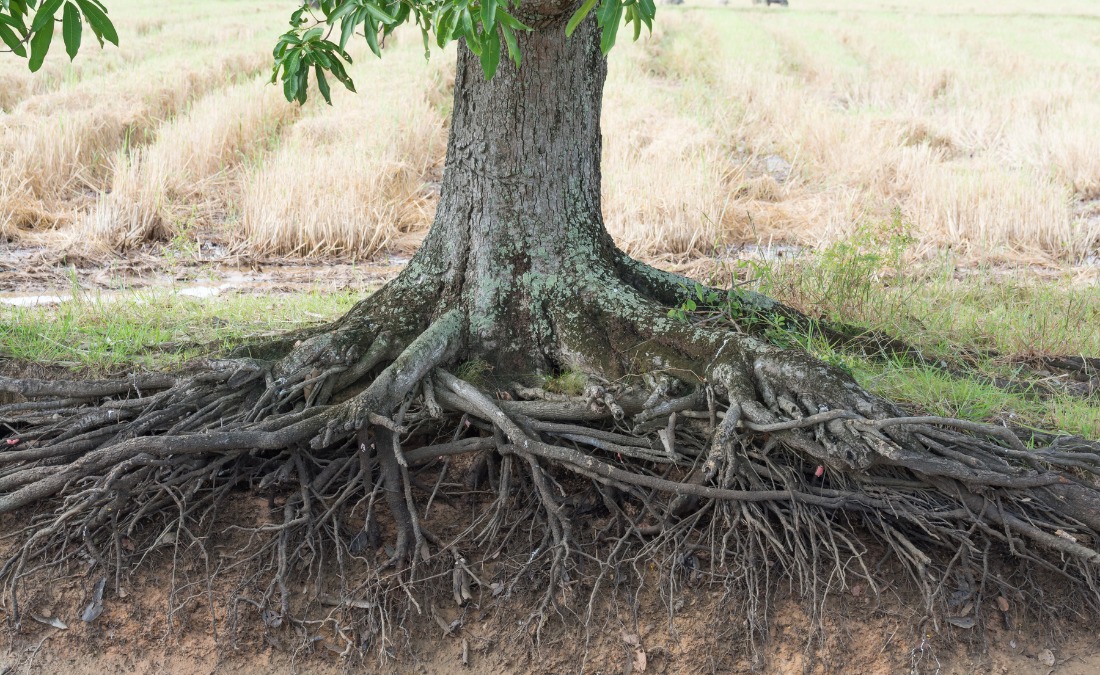
Bettendorf and North Scott County soils vary greatly, from glacial till ridges to river corridor. Learn why deep root fertilization must match your soil.
Across Bettendorf, Eldridge, and Pleasant Valley, the same pattern repeats itself every spring. Trees that looked okay last summer push out smaller leaves, thinner canopies, or foliage tinged with yellow that has nothing to do with fall color. The problem isn’t above ground either; it’s below it.
Deep root fertilization addresses what surface-applied products can’t: nutrient deficiencies locked deep in compacted urban and suburban soils where tree roots live. And in North Scott County, that challenge is amplified by how much soil conditions can vary from one neighborhood to the next — something a generic fertilizer program doesn’t account for.
Key Takeaways
- Deep root fertilization directly injects nutrients into the root zone by bypassing turfgrass competition and soil compaction.
- Soil in North Scott County varies dramatically — glacial till upland in Bettendorf and Eldridge acts quite differently than alluvial river corridor soil near Le Claire and Pleasant Valley.
- An individually tailored formulation based on soil testing delivers what your trees need, not a basic one-size-fits-all blend.
- Yellowing leaves with green veins, stunted growth, and thin canopies are common indicators that trees aren’t getting proper nutrition from the soil.
- An ISA Certified Arborist can identify the specific soil and nutrient issues impacting your trees.
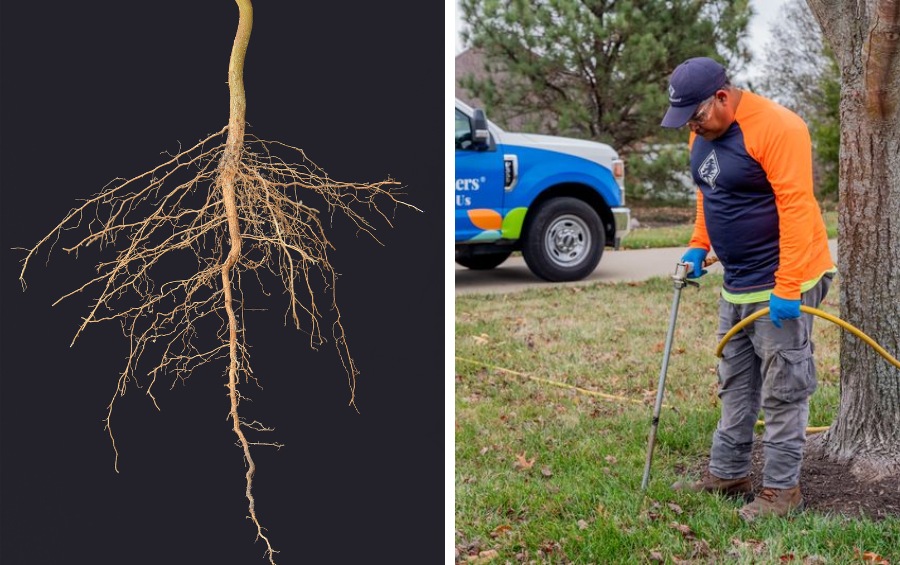
Deep root fertilization delivers nutrients directly to the feeder root zone, where trees actually absorb them — bypassing the turfgrass competition that intercepts surface-applied products.
What Is Deep Root Fertilization?
Deep root fertilization is a process where liquid fertilizer is injected under pressure directly into the soil at about five to eight inches deep, as this is the zone where most tree feeder roots concentrate. An arborist works in a grid pattern from the trunk outward to the dripline and sometimes beyond it, placing injections at consistent intervals to ensure even coverage across the root zone.
This technique does two things that surface-level fertilizer can’t:
- It bypasses the dense mat of turfgrass roots that sits in the top few inches of soil. When you spread granular fertilizer around a tree, the lawn absorbs most of it before it reaches the tree’s roots.
- The pressured injection of deep root fertilization physically breaks through compacted soil, which then opens channels for oxygen and water to reach the root system.
Many homeowners don’t realize: that compaction piece matters a great deal. Urban and suburban soils bear almost zero resemblance to the floor of a forest, where decades of decomposing leaves and organic material keep soil loose and rich in nutrients. Foot traffic, construction activity, and closeness to driveways, sidewalks, and foundations compact the soil into a dense layer that gradually suffocates roots.
PRO TIP: Knowing how deep root fertilization works is only part of the picture. What goes into the injection and whether it matches the needs of your soil is what differentiates a real fertilization program from a costly guess.
Why Does North Scott County Soil Vary So Much?
In North Scott County, the soil under your property is not the same as your neighbor’s a few miles down the road. That has everything to do with how the land was formed. Two different geological processes shaped this area, and each left behind a unique soil profile with its own set of obstacles to tree health.
Glacial Till Upland in Bettendorf and Eldridge
The higher ground running through Bettendorf and Eldridge sits on glacial till, which is dense material deposited by retreating glaciers and topped with a layer of wind-blown silt called loess. This results in silt loam to silty clay loam on the surface with heavy, clay-rich subsoils underneath.
These soils tend to have a higher pH, usually edging above 7.0 into alkaline territory. Alkaline conditions lock up iron and manganese in the soil, which makes them chemically unavailable to tree roots even when those minerals are physically present. This is a well-documented issue for trees and shrubs in alkaline soil conditions across Iowa. During construction, topsoil is stripped away and never properly replaced, with trees planted in alkaline clay subsoil.
Alluvial River Corridor in Le Claire and Pleasant Valley
As you get closer to the Mississippi, the story changes. Soil in Le Claire and Pleasant Valley were deposited by river action over thousands of years. This created an alluvial profile that looks entirely different from the upland glacial till. These soils alternate between layers of sand, silt, and clay.
Generally, the alluvial corridor is more fertile than the upland, but those stratified layers mean nutrient availability changes the deeper you go. A tree’s feeder roots might sit in rich silt at one depth and hit nutrient-deficient sand six inches lower. History of flooding also plays a role, as it affects organic matter distribution and soil composition in ways that vary from one property to another.
Organizations like the Scott County Soil and Water Conservation District have continually documented how drastically soil conditions change across even short distances in this part of Iowa. A soil analysis prior to treatment isn’t optional; it is the only way to know exactly what your property needs.
What Goes Into a Customized Deep Root Fertilization Treatment?
A specifically tailored deep root fertilization treatment begins with something most generic programs tend to skip: a thorough soil analysis. Before anything goes into the ground, Arbor Masters tests your soil to identify what is exactly missing, what’s locked up, and what the pH is doing to nutrient availability.
Depending on those results, the formulation is centered around the actual needs of your trees. Typically, that includes macronutrients such as nitrogen, phosphorus, and potassium, but the ratios can vary depending on what the soil tests reveal. A property in Eldridge sitting on alkaline clay needs a much different NPK balance than a Le Claire property with layers of sandy alluvial.
Basics aside, a customized blend usually includes micronutrients like iron, manganese, and zinc, which are crucial in higher-pH upland soil where these elements are chemically locked out. Mycorrhizae, a beneficial fungus that greatly extends a root system’s ability to absorb water and nutrients, is another important component.
Humic and fulvic acids act as soil conditioners that improve structure and nutrient availability, while bio-stimulants (amino acids) support the development of roots and help trees bounce back from stress.
This is not the same as a lawn care company spreading granular fertilizer around the base of your trees. Arbor Masters delivers three to five applications over a period of twelve months as part of a comprehensive deep root fertilization services program, not a single treatment.
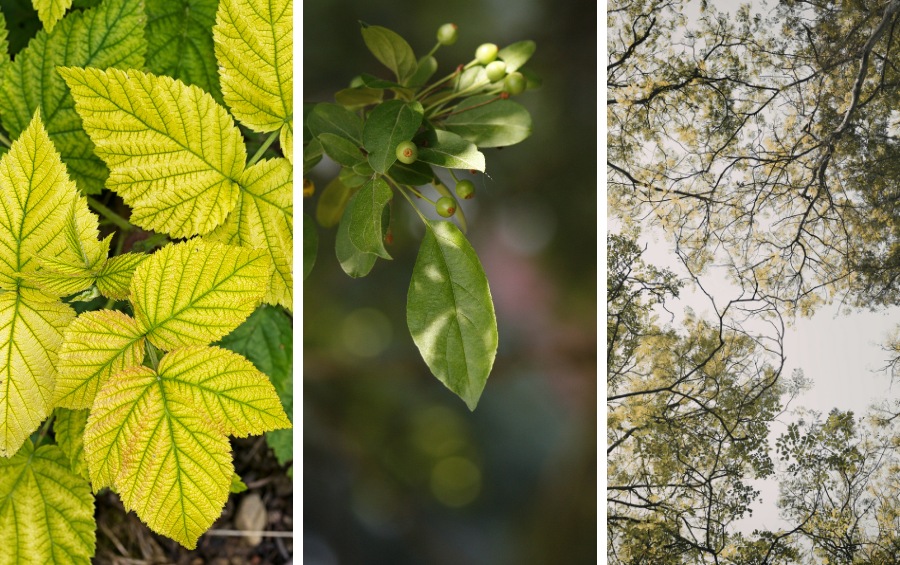
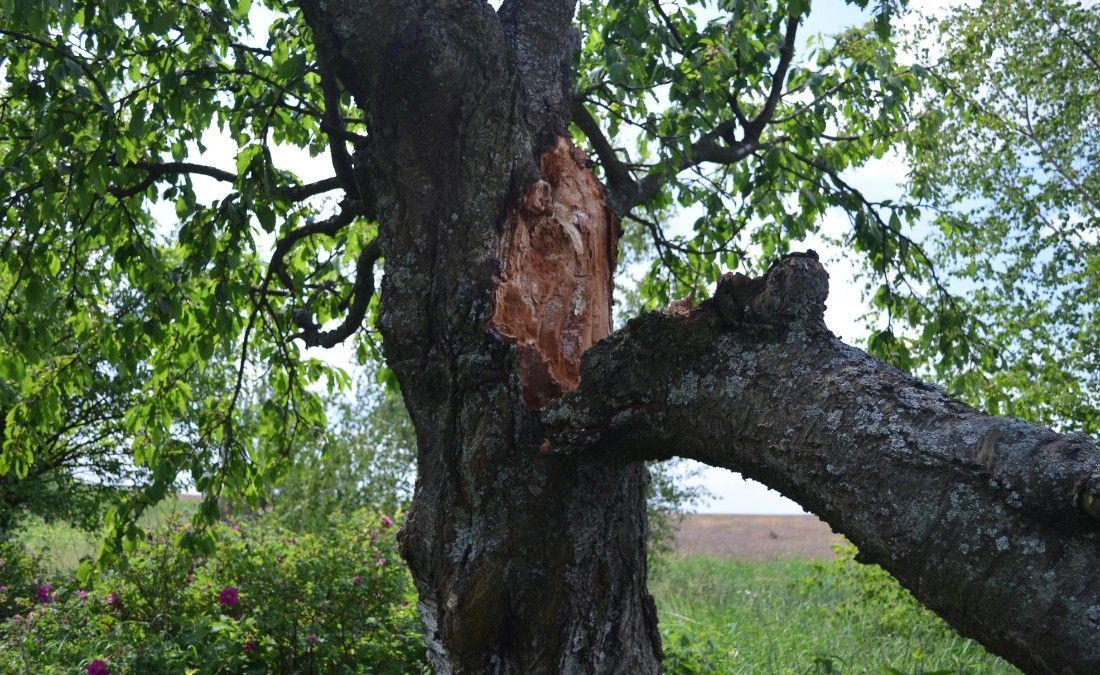
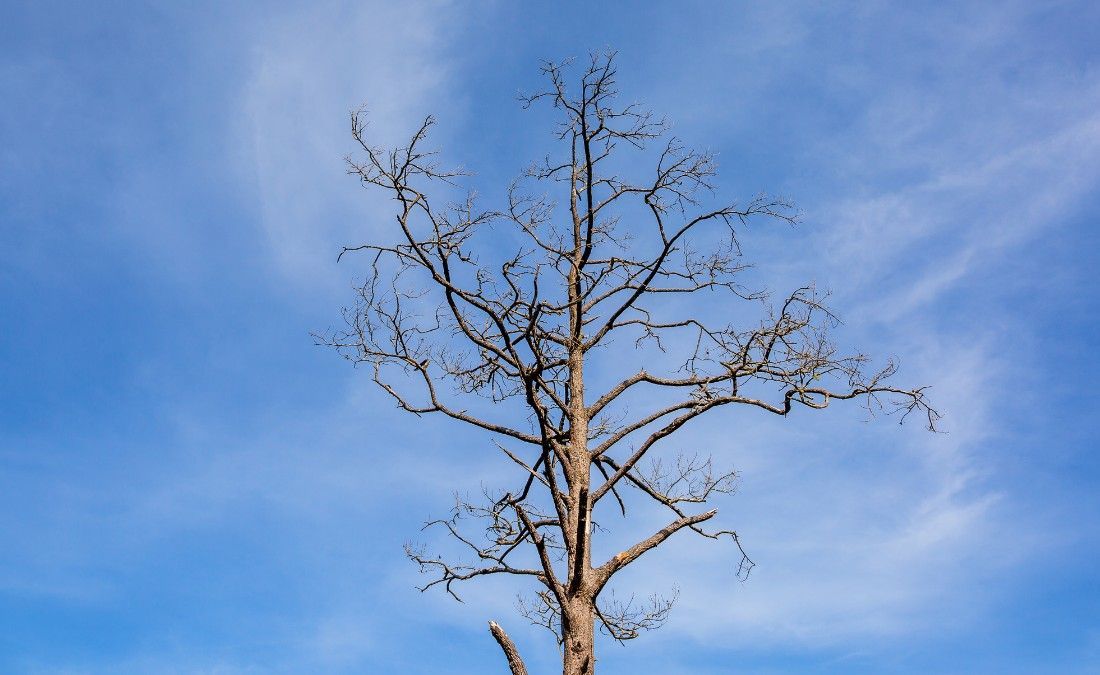
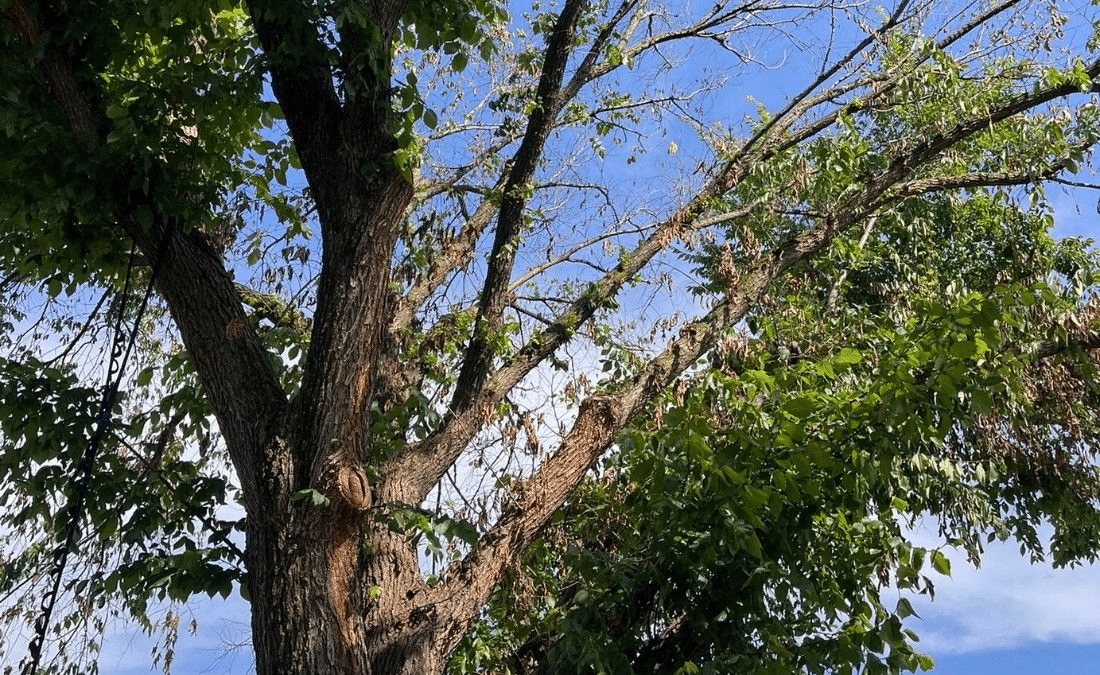
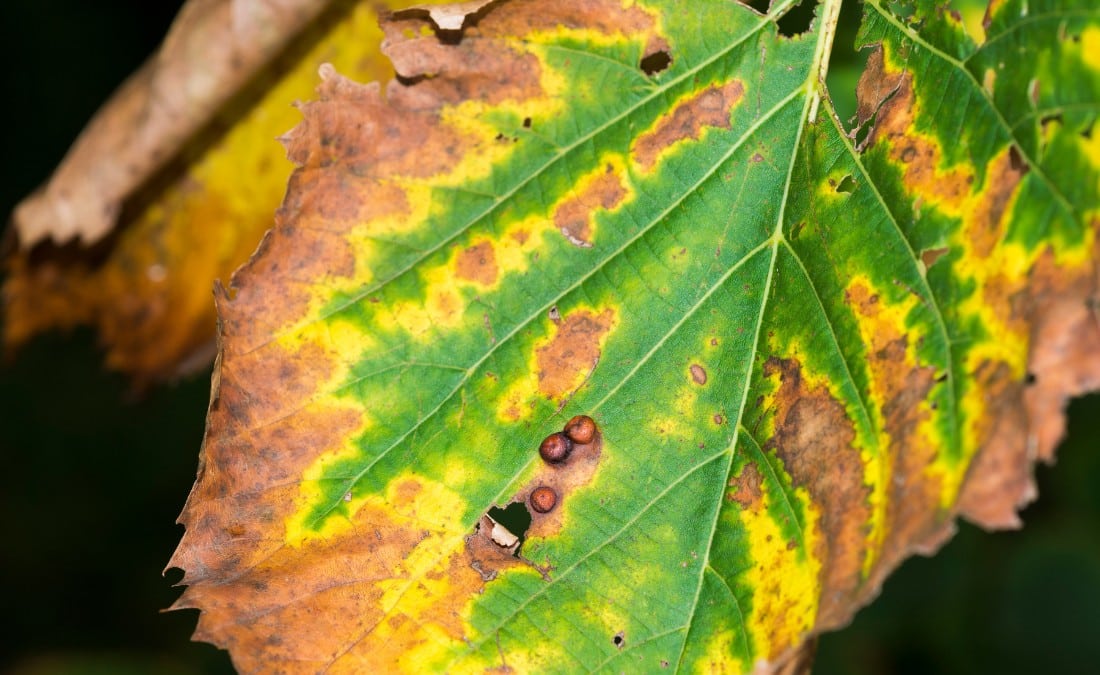
Common warning signs of nutrient deficiency: yellowing leaves with green veins (left), stunted or uneven leaf development (center), and a thinning canopy where more sky is visible through the crown (right).
What Are the Signs Your Trees Need Deep Root Fertilization?
Trees can’t tell you when they’re hungry. They can show you, though. Several visible symptoms indicate nutrient deficiencies that deep root fertilization is designed to correct and catching them early makes a major difference in the outcomes of treatment.
Warning signs can be:
- Yellowing leaves with green veins (interveinal chlorosis), a distinctive pattern that usually points to iron or manganese deficiency tied to high soil pH, and it is especially common in Bettendorf and Eldridge
- Noticeably slow or stunted new growth compared to prior seasons
- Smaller-than-normal leaves for the species
- A sparse or thin canopy where you can see more sky through the crown than you used to
- Leaves falling earlier than expected or poor fall color development
- Dieback at branch tips, where small twigs and outer branches progressively die back
The yellowing-with-green-veins pattern calls for special attention. It is a trademark of iron chlorosis in trees, which is widespread in Iowa’s alkaline soils. If you are seeing it on your pin oaks, river birches, or maples, the soil pH is almost certainly a contributing factor.
Keep in mind: not every symptom points to the same deficiency. Some of these signs can also point to insect and disease issues instead of nutritional problems. An ISA Certified Arborist can distinguish between nutrient deficiency, disease or pest problems, and environmental stress. That professional diagnosis is a vital first step before any treatment can start.
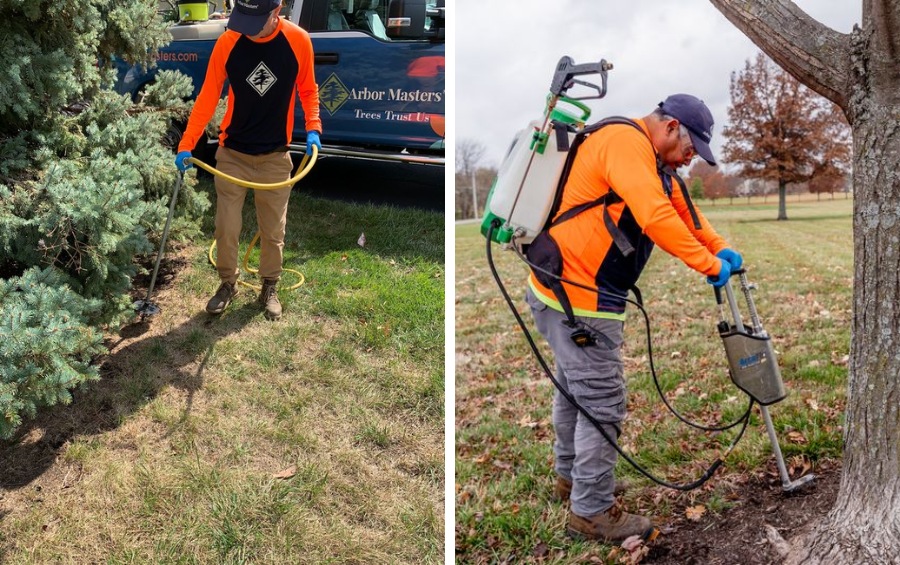
Arbor Masters PHC technicians use professional-grade injection equipment to deliver custom-blended fertilizer formulations into the root zone of trees across North Scott County.
Frequently Asked Questions About Deep Root Fertilization
Is deep root fertilization worth it?
For trees in urban and suburban landscapes, deep root fertilization provides nutrients where surface applications simply can’t reach. It is especially valuable for mature trees that represent a large portion of your property’s value and curb appeal.
When is the best time for deep root fertilization?
Early spring and fall are the primary windows for treatment. Spring applications support active growth, while fall treatments help trees store nutrients before dormancy. Arbor Masters usually provides three to five applications across a 12-month span to sustain consistent nutrient availability.
How deep do arborists inject fertilizer during deep root fertilization?
Injections are placed around five to eight inches deep, which is where most tree feeder roots concentrate. The arborist works in a grid pattern from the trunk outward to the dripline, sometimes going beyond it, to ensure the complete root zone is covered.
Can I do deep root fertilization myself?
Professional-level deep root fertilization requires specialized high-pressure injection tools and custom-blended formulations based on the results of soil tests. Homeowner-grade root feeder attachments for garden hoses don’t provide the same pressure, coverage, or tailored nutrient blend that a professional program does.
What’s the difference between deep root fertilization and regular tree fertilizer?
Surface-applied granular fertilizers sit on the top of the soil where turfgrass roots absorb most of them before the tree roots can benefit. Deep root fertilization directly injects liquid nutrients into the root zone at depth. This completely bypasses turf competition and aerates compacted soil at the same time.
How do I know if my soil needs to be tested before fertilization?
Every property benefits from a soil test before fertilization. Soil conditions can vary greatly within the same neighborhood in North Scott County. A property on one side of a subdivision can have quite different pH and nutrient levels than one across the street. A soil analysis is the only dependable way to determine the proper formulation for your trees.
Get the Fertilizer Your Trees Need From Arbor Masters
In Bettendorf, Eldridge, Le Claire, or Pleasant Valley, the soil under your property isn’t the same as your neighbor’s. Deep root fertilization works because it puts the proper nutrients in the right place at the right depth. It only brings tangible results when the formulation is matched to the soil’s exact needs. This treatment is one of the most effective tree preservation services available.
Ready to dig into what’s actually happening in your soil? Schedule your soil analysis and free quote with Arbor Masters to get a deep root fertilization program specifically tailored to your property’s trees.
Want More Like This?
Get the latest local news, tree care tips, special offers, and company updates directly to your inbox! It's easy to subscribe and there's no spam - we promise.
"*" indicates required fields
