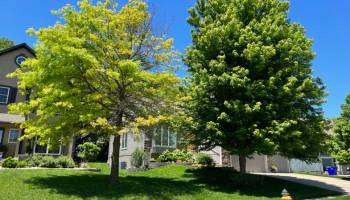
Why Overland Park’s Oldest Neighborhoods Are Losing Their Tree Canopy (and What Homeowners Can Do)
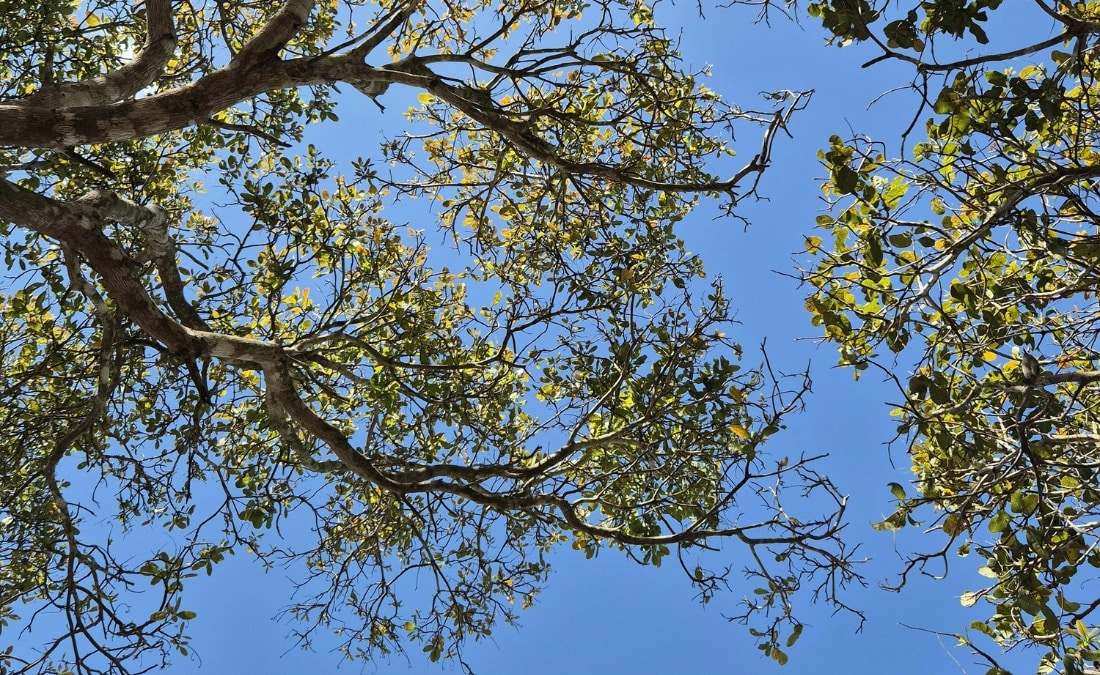
Overland Park’s older neighborhoods are losing the mature trees that once defined them. Learn how to protect the canopy on your property.
If you live in Wycliff or Westbrooke South, you’ve probably noticed survey stakes, bright utility markers, and orange ribbons tied around tree trunks this spring. They’re the first visible step in a multi-year street reconstruction project that will reshape both neighborhoods — and the mature tree canopy along with them.
And while most attention goes to the trees marked for removal along the street, construction impacts often extend beyond the curb line. Nearby root disturbance, soil compaction, and grade changes can stress mature trees on private property long before symptoms become obvious.
Key Takeaways
- Two city programs are driving the loss: the Neighborhood Street Reconstruction Program, which will rebuild streets across more than 20 neighborhoods over the next decade, and the removal of roughly 8,000 remaining ash street trees.
- Three Overland Park neighborhoods are in recent or upcoming development phases: Moody Hills (completed in 2025), Westbrooke South (through October 2026), and Wycliff (spring 2026 through fall 2027).
- Nearby street construction can slowly kill private trees through root damage, soil compaction, and grade changes, with symptoms sometimes taking 2-5 years to appear.
- A baseline arborist assessment before work begins is the single most effective step for protecting mature trees on your property.
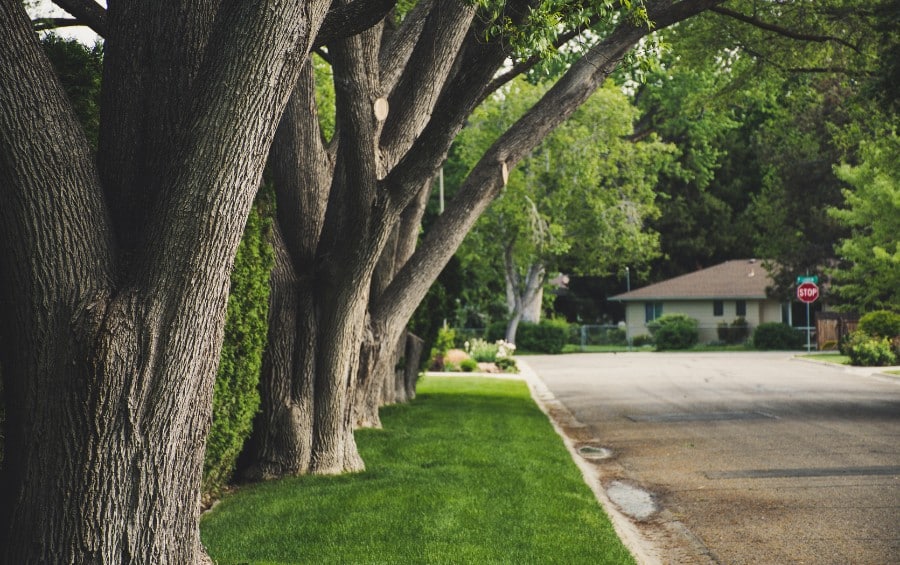
Mature trees bring shade, protection, and even property value to your yard. However, they sometimes need to be removed due to EAB invasion or road-widening projects.
What’s Happening to Overland Park’s Tree Canopy?
Overland Park is losing mature street trees to two city programs running concurrently through its oldest neighborhoods: the Neighborhood Street Reconstruction Program, which aims to rebuild aging residential streets, and the ongoing ash tree removal after emerald ash borer. The overlap is why residents in neighborhoods like Moody Hills and Westbrooke South are noticing sudden gaps where large crowns used to be.
Street Reconstruction Is the Bigger Driver
Street reconstruction claims more canopy than any other cause right now because every project begins by removing the mature trees whose roots conflict with new curbs, gutters, and storm drains. The Neighborhood Street Reconstruction Program is scheduled to rebuild streets across more than 20 neighborhoods over the next decade.
And because the scope of the project is concentrated in the oldest parts of the city, residents in neighborhoods built 60-plus years ago are the ones seeing the most dramatic changes.
Emerald Ash Borer Is Driving the Second Wave
Where reconstruction removes trees by neighborhood, emerald ash borer is removing them by species — and ash made up nearly a quarter of Overland Park’s street canopy. Of roughly 11,000 ash street trees counted in 2014, about 3,000 are already gone. The remaining 8,000 are being removed proactively before they die and become structurally dangerous.
Our team has been working alongside the city on the ash removal program, and the goal has never been just to eliminate the trees. Each ash that comes down is replaced with a species from the city’s diversified planting list, which is building a canopy less vulnerable to the next pest outbreak than the ash-dominant one it’s replacing.
Which Overland Park Neighborhoods Are Losing Trees to Street Reconstruction?
Three neighborhoods in the Overland Park area are in recent, active, or upcoming phases of the program:
- Moody Hills (completed 2025): Dozens of mature oaks removed; stumps now visible along streets that were fully canopied a year ago.
- Westbrooke South (2026, in progress): Streets built between 1962 and 1966 are being rebuilt now; work wraps in October 2026.
- Wycliff (2026–2027): Southwest of 103rd Street and U.S. 69; utility relocation started fall 2025, active construction begins this spring, work continues through fall 2027.
Future phases of the program are scheduled through the rest of the decade, with additional neighborhoods added each year.
How Can Nearby Construction Damage Trees on Your Property?
A tree’s root system extends 2-3 times wider than its canopy, which means nearby construction can damage your trees even when no equipment ever crosses your lot line. Three mechanisms do most of the damage: cutting roots during trenching, compacting soil under heavy equipment, and changing the grade around the root zone.
Severed Roots from Trenching and Curb Work
Trenching for utilities and excavation for new curbs cut through tree roots that extend into the right-of-way. Because roots typically spread much wider than the canopy, with most living in the top 12-18 inches of soil, they’re well within reach of the shallow trenches used for water lines, gas lines, and curb work. And when a meaningful share of a mature tree’s roots gets cut, it loses both stability and its primary water and nutrient uptake system.
Soil Compaction from Heavy Equipment
Soil compaction happens when the weight of construction equipment presses the soil down and squeezes out the air pockets roots need to breathe. A single pass by a loaded dump truck or excavator can do permanent damage, and Kansas City’s heavy clay soils are especially vulnerable. The effect is invisible — the tree may look healthy for one or two seasons, then begin a decline that’s hard to trace to its cause.
Grade Changes Around the Root Zone
Grade changes damage trees by altering the soil depth around their root zone. When reconstruction requires different slopes than the original streets had, crews add or remove soil to match modern standards — and even a few inches of added soil can suffocate roots, while removing too much soil exposes and injures the root flare. Oaks and sugar maples, the dominant species in Overland Park’s older neighborhoods, are especially vulnerable to grade changes, and once the root flare is damaged, the tree’s decline is often irreversible.
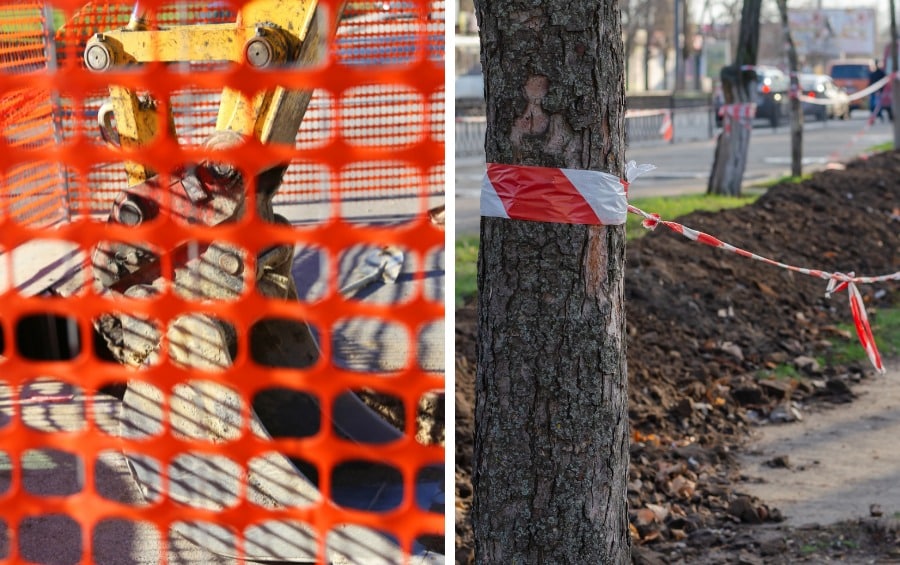
What Are the Signs of Construction Damage to Trees?
Trees damaged by nearby work rarely show stress immediately — the symptoms appear quietly, over seasons, and the tree often looks fine at first glance. Walk your property and watch for any of the following:
- Leaves wilting, curling, or browning at the edges during normal weather
- A canopy that’s thinning or noticeably sparser than neighboring trees of the same species
- Premature fall color or early leaf drop in midsummer
- Fresh bark cracks, peeling bark, or visible cambium damage on the trunk
- New woodpecker activity, which often signals wood-boring insects moving into a stressed tree
- Mushrooms or conks appearing on the trunk
What usually catches homeowners off guard is the delay; construction stress can take 2-5 years to kill a tree. A tree that “made it through” the construction season isn’t necessarily safe, which is why annual monitoring is the right baseline for any tree within root-reach of recent work. Catching these changes early — before they become irreversible — is the goal of targeted tree preservation care.
PRO TIP: Walk to the far side of the street once a month and look up into your canopy. A thinning crown is much easier to spot from a distance than from directly underneath the tree.
What Should You Do to Protect the Trees You Still Have?
Protecting mature trees on your property comes down to three things:
- Documenting their baseline health with an arborist assessment
- Establishing a physical protection plan around the root zone
- Committing to ongoing plant health care through and after the project
The timing of each shifts depending on where your neighborhood is in the construction cycle.
Get a Baseline Assessment Before Construction Begins
Start with an arborist consultation to document each tree’s baseline health. Photos, canopy condition, and trunk diameter give you a reference point if problems appear 2 or 3 years from now. Identify the trees closest to the right-of-way and ask about a protection plan — fencing the root zone, applying deep mulch, and keeping activity out of that area. This is also the moment for proactive deep-root fertilization, which strengthens trees before a stress event.
Protect the Root Zone During Construction
Keep equipment, stockpiled materials, and foot traffic outside the root protection zone whenever you can. Water deeply during dry stretches — a stressed tree needs consistent moisture more than a healthy one does. Document any damage you observe — crushed limbs, soil piled on roots, equipment parked beneath the canopy — with dated photos.
Monitor Tree Health After Construction Ends
Schedule a follow-up arborist assessment about a year after the crews leave — that’s when the first signs of decline typically appear. Plan on consistent plant health care for at least 5 years, the window when construction damage fully reveals itself. If the city planted a replacement tree near your property, water it deeply once a week through its first 2 summers. Young street trees rarely make it without that attention.
Frequently Asked Questions About Overland Park’s Tree Canopy Loss
Who is responsible for caring for street trees in Overland Park?
In Overland Park, the adjacent homeowner is responsible for watering, mulching, and routine care of street trees in the public right-of-way. The city handles removal of dead or hazardous trees and replaces them, but ongoing survival depends largely on the homeowner.
How close is too close when construction is near my tree?
A widely used guideline is that the root protection zone extends roughly one foot from the trunk for every inch of trunk diameter. A 24-inch oak has a root protection zone of 24 feet in every direction, and any disturbance inside that zone deserves attention.
Will the city notify me before removing a tree near my property?
The city conducts neighborhood-level tree assessments during project design and communicates through project notices, neighborhood meetings, and its program website. The city’s neighborhood street reconstruction page carries current timelines and contact information.
Does homeowners insurance cover tree damage caused by nearby city construction?
Most standard homeowners policies don’t cover tree damage from routine municipal work. Your stronger path is documenting your trees’ pre-construction condition with dated photos and filing any claim directly with the city’s public works department.
Can I ask the city to preserve a specific tree during street reconstruction?
The city’s foresters walk each neighborhood tree by tree during the design phase, and there’s typically a window when residents can raise questions about specific trees before removal decisions are finalized. Contacting the project team early in design is when input has the most influence.
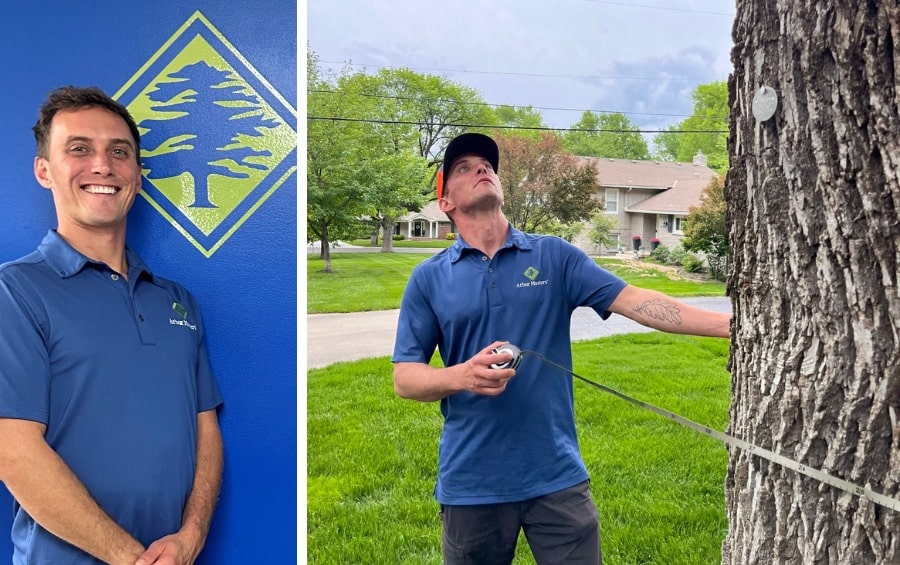
A baseline assessment from one of our ISA Certified Arborists documents your tree’s condition before construction begins, giving you a reference point if problems appear years later.
Get Help Protecting Your Overland Park Trees Before Construction Begins from Arbor Masters
Protecting your trees starts with a professional assessment before the equipment arrives. The stakes and ribbons appearing across Wycliff and Westbrooke South this spring aren’t going to stop — and neither is the slow-motion canopy change they represent. Homeowners with mature trees still standing have the chance to protect them now — before construction reaches their block.
You can’t stop the city’s work, but you can decide whether your trees are monitored and supported through it. The ISA Certified Arborists and Board Certified Master Arborists at Arbor Masters have been caring for Kansas City trees since 1960, and we’ve been working alongside the city on the ash removal program long enough to know how construction stress shows up — and how to get ahead of it.
Call 913-441-8888 or request a quote online to meet with our Overland Park team now — not after the orange ribbons go up.
Want More Like This?
Get the latest local news, tree care tips, special offers, and company updates directly to your inbox! It's easy to subscribe and there's no spam - we promise.
"*" indicates required fields