
Is Bacterial Leaf Scorch Killing Your Quad Cities Oak or Elm Tree?
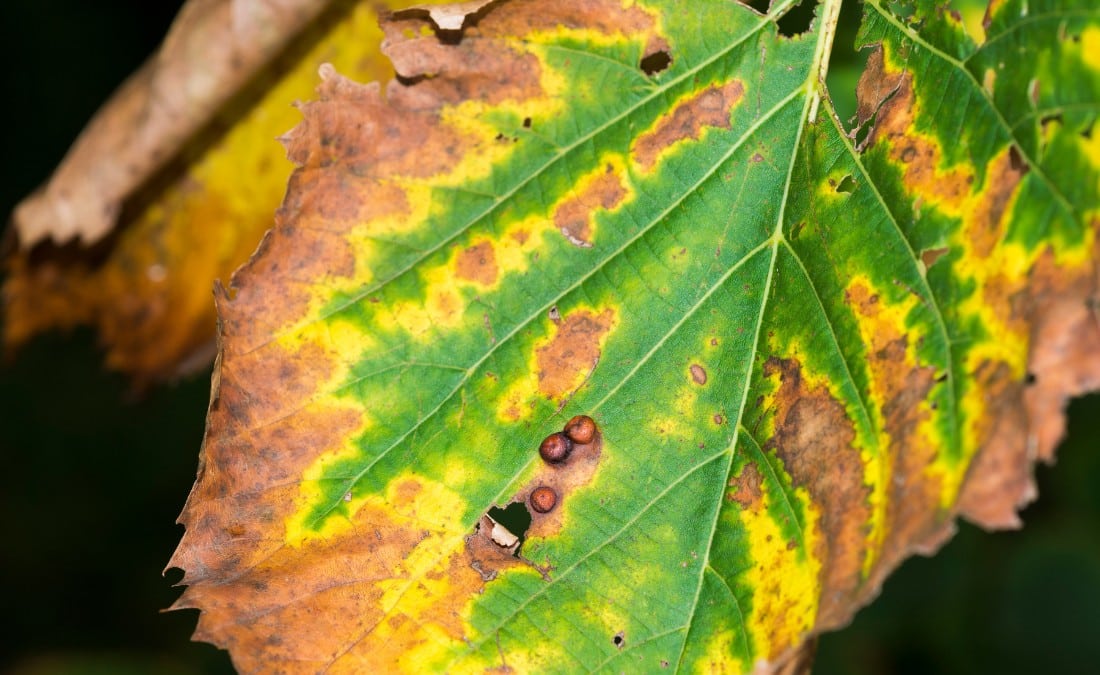
Bacterial leaf scorch is manageable, not curable. Learn how Quad Cities homeowners identify it, confirm it, and extend a tree's life with expert PHC care.
In late summer across the Quad Cities, mature oaks and elms start showing crisp, brown edges that curl inward while the center of each leaf remains green. On red oaks, pin oaks, and elms especially, that edge-first browning is typically bacterial leaf scorch, a disease that slowly restricts the tree’s ability to move water.
The challenge is that bacterial leaf scorch isn’t the only condition that causes browning leaves. Oak wilt, drought stress, and other problems can produce similar symptoms, but they require very different responses. Identifying the cause early is the best way to determine whether your tree needs long-term management or more immediate intervention.
Key Takeaways
- Bacterial leaf scorch is a bacterial infection (Xylella fastidiosa) that clogs a tree’s water-carrying tissue, browning the leaf margins from mid-summer on.
- A yellow or reddish band between the dead edge and the green center is the key sign that separates this disease from ordinary drought scorch.
- There is no cure, but the disease is manageable, and mature trees often decline slowly over years rather than dying quickly.
- Laboratory testing is the only way to confirm bacterial leaf scorch and distinguish it from other causes of summer leaf browning.
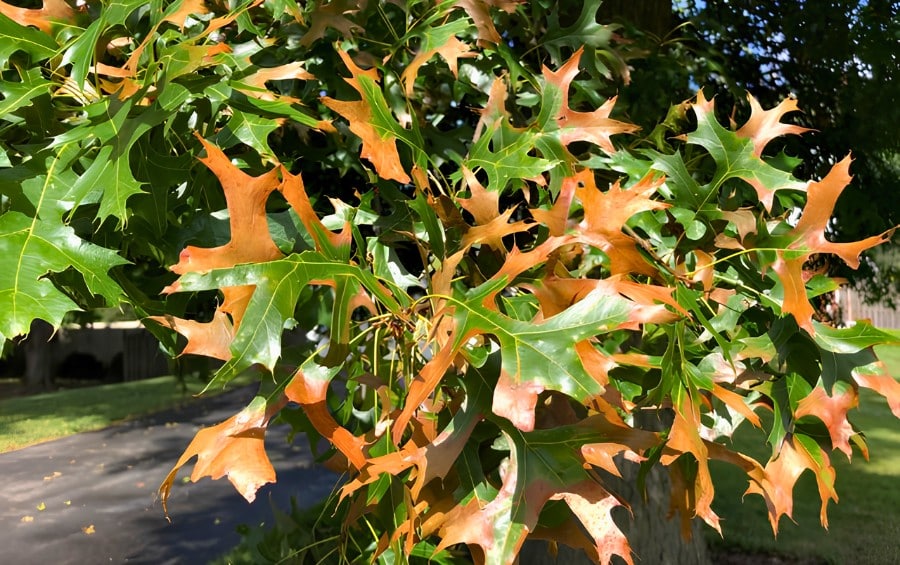
Margin-first browning on a pin oak, one of the red oak group species most at risk for bacterial leaf scorch in the Quad Cities.
What Is Bacterial Leaf Scorch?
Bacterial leaf scorch is a disease caused by Xylella fastidiosa, a bacterium that lives inside a tree’s xylem, the plumbing that carries water from the roots up to the leaves. As the bacteria multiply, they clog those vessels, halting water from reaching the leaf edges, and causing the margins to dry out and turn brown.
How Can You Identify Bacterial Leaf Scorch?
The single most useful sign is a yellow or reddish band that separates the dead leaf edge from the still-green center. On a tree with bacterial leaf scorch, that halo is usually visible where the brown tissue meets the healthy tissue. Browning caused by heat, drought, or salt exposure typically doesn’t cause that band.
When Do Symptoms First Appear?
Symptoms show up in the middle of summer and get worse the closer fall gets. They tend to start on leaves like the:
- Lower
- Interior
- Older
Then, they spread outward toward the branch tips over the coming seasons. That pattern is another way it’s different from drought scorch, which typically hits the newest growth first.
Which Quad Cities Trees Are Most at Risk?
The most at-risk trees are in the red oak group, along with elm and other shade trees. The most susceptible species are:
- Northern red oak
- Pin oak
- Shingle oak
- Elm
- Sycamore
- Sweetgum
- Hackberry
- Some maples
On the Illinois side of the Quad Cities, bacterial leaf scorch is documented and increasing. It’s a growing concern across the Upper Midwest, so a mature oak or elm in Rock Island or Moline with mature canopy is worth watching.
How Is Bacterial Leaf Scorch Different from Other Tree Problems?
Brown leaf edges don’t automatically mean bacterial leaf scorch. Several common tree problems produce similar symptoms, but they differ in how quickly they spread, where symptoms appear, and whether treatment is urgent.
| Condition | What You’ll See | Timing | How Serious Is It? |
|---|---|---|---|
| Bacterial Leaf Scorch | Brown leaf margins with a yellow or reddish band separating the dead tissue from the green center. Symptoms begin on older, interior leaves. | Mid-to-late summer, worsening into fall | Slow decline over several years; manageable but not curable. |
| Oak Wilt | Rapid wilting and browning that often starts in the upper canopy. No yellow halo. | Spring through summer | Urgent. Red oaks can die within weeks. |
| Drought or Heat Stress | Uniform browning or leaf scorch without a distinct halo, often affecting exposed or upper-canopy leaves. | During hot, dry weather | Usually improves when watering and weather conditions improve. |
| Oak Anthracnose | Brown blotches along leaf veins with curled or distorted leaves. | Following a cool, wet spring | Usually cosmetic and rarely fatal. |
How Do You Confirm Bacterial Leaf Scorch in the Quad Cities?
Although the symptoms can strongly suggest bacterial leaf scorch, a laboratory test is the only way to confirm the diagnosis. The best time to test is in late summer or early fall, when bacterial populations are high enough to detect reliably. Testing too early in the season can result in a false negative.
Where Can Quad Cities Homeowners Have Their Trees Tested?
Depending on which side of the river you’re on, you’ll send the samples to:
- The Iowa State University Plant & Insect Diagnostic Clinic (Davenport, Bettendorf, Pleasant Valley)
- The University of Illinois Plant Clinic (Rock Island, Moline, East Moline)
Both labs publish current submission information, so check their sites for up-to-date details before mailing anything in.
How Do You Collect a Sample?
To collect a good sample for the lab, you should:
- Pick leaves showing early scorch that are still partly green, not leaves that are completely brown and dead.
- Keep the leaf stems (petioles) attached, since that’s the tissue the lab tests.
- Seal the leaves in a bag, refrigerate them, and submit the same day or the next.
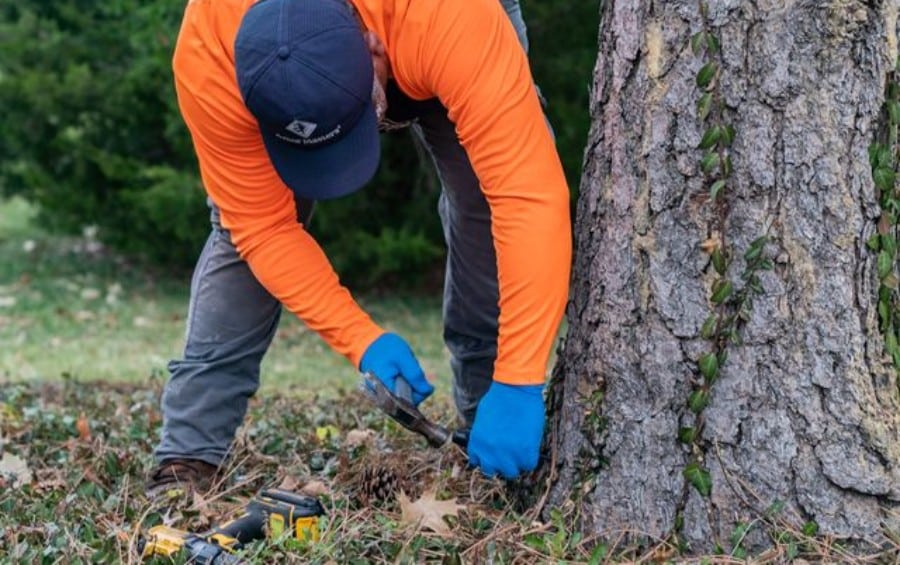
Spring root-flare injections of oxytetracycline can suppress bacterial leaf scorch symptoms, but they have to be repeated every year.
Can a Tree With Bacterial Leaf Scorch Be Saved?
Although bacterial leaf scorch can’t be cured, it also doesn’t mean your tree needs to be removed. Many infected oaks and elms continue providing shade and landscape value for years with proper monitoring and care. The goal shifts from curing the disease to slowing decline and maintaining the tree’s health for as long as possible.
Will My Tree Need to Be Removed?
Not necessarily. Bacterial leaf scorch typically progresses slowly, with symptoms becoming more severe over several growing seasons. As long as the tree remains structurally sound and continues to provide value, monitoring and managing the disease is often the better approach. Removal usually isn’t recommended until the tree has declined beyond recovery or becomes a safety risk.
Do Antibiotic Injections Work?
Antibiotic injections suppress symptoms of bacterial leaf scorch, but they don’t reverse the disease. In a study on pin oaks, spring root flare injections of oxytetracycline reduced scorch and pushed back the appearance of late-summer symptoms by around two weeks.
The effects only last a season, so these injections have to be annually repeated. This is why they’re reserved for high-value specimen trees instead of every tree in your yard.
How Do You Keep an Infected Tree Healthy?
The most dependable way to extend a tree’s life is to keep it as vigorous as possible, which means:
- Consistent watering during dry spells and a proper mulch ring to hold soil moisture
- Relieving soil compaction and avoiding root-zone damage
- Pruning out dead and dying limbs, with tools disinfected between cuts
This is what a plant health care program is designed to do. Our professional insect and disease treatment pairs that ongoing care with a plan specifically tailored to your trees.
Frequently Asked Questions About Bacterial Leaf Scorch
What causes bacterial leaf scorch?
Bacterial leaf scorch is caused by Xylella fastidiosa, a bacterium that lives in the tree’s water-conducting tissue and blocks the flow of water to the leaves. As water delivery drops, the leaf margins dry out and turn brown.
How is bacterial leaf scorch spread?
It’s spread mainly by xylem-feeding insects such as leafhoppers and spittlebugs, and sometimes through root grafts between neighboring trees. The tree-to-tree spread tends to be slow rather than explosive.
How long can a tree live with bacterial leaf scorch?
Many trees live five to eight years from the first symptoms and decline slowly instead of just dying in one season.
Is bacterial leaf scorch contagious to my other trees?
It can move to nearby trees through insect feeding and shared root grafts, so other susceptible trees can be at a slight risk.
Should I remove a tree with bacterial leaf scorch?
Not necessarily, and also often not immediately. Generally, removal only makes sense once decline is advanced and large limbs start dying back, since many trees keep years of useful, shade-giving life with supportive care.
Does bacterial leaf scorch affect elms differently than oaks?
Elms are susceptible, too, and their symptoms are similar to what shows up on oaks. The wrinkle is that in elms, bacterial leaf scorch can be mistaken for Dutch elm disease, so a lab test matters even more when confirming what you’re dealing with.
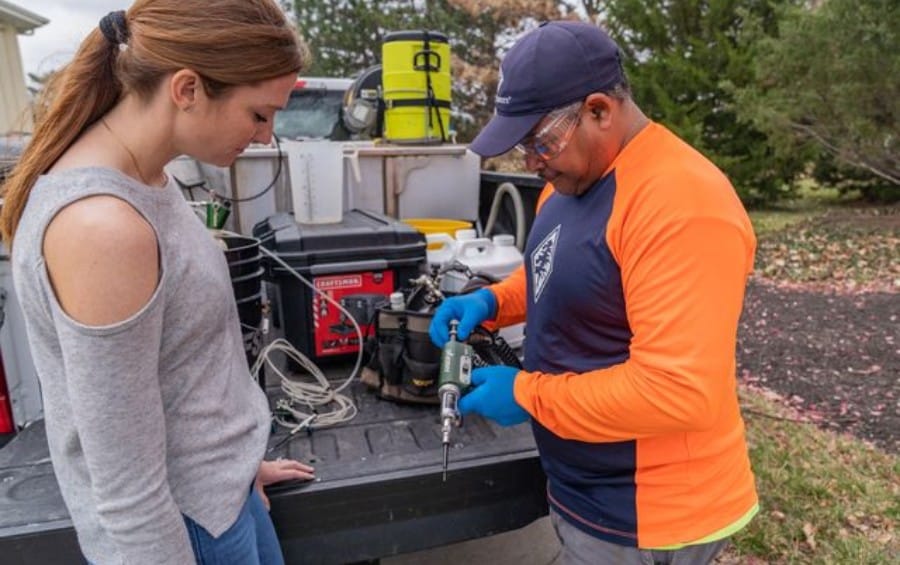
An Arbor Masters PHC technician readies an injection treatment, one option reserved for high-value specimen trees.
If You Spot Bacterial Leaf Scorch, Contact Arbor Masters
If your trees in the Quad Cities are showing signs of bacterial leaf scorch, the ISA Certified Arborists at Arbor Masters of Davenport can look at it, coordinate testing, and build a continuous plan involving injections, cultural care, and monitoring decline.
To extend your tree’s life instead of just removing it, call us at 563-355-7508 or reach out to us online today!
Want More Like This?
Get the latest local news, tree care tips, special offers, and company updates directly to your inbox! It's easy to subscribe and there's no spam - we promise.
"*" indicates required fields
