
How to Save a Damaged Tree in Dallas County After a Storm
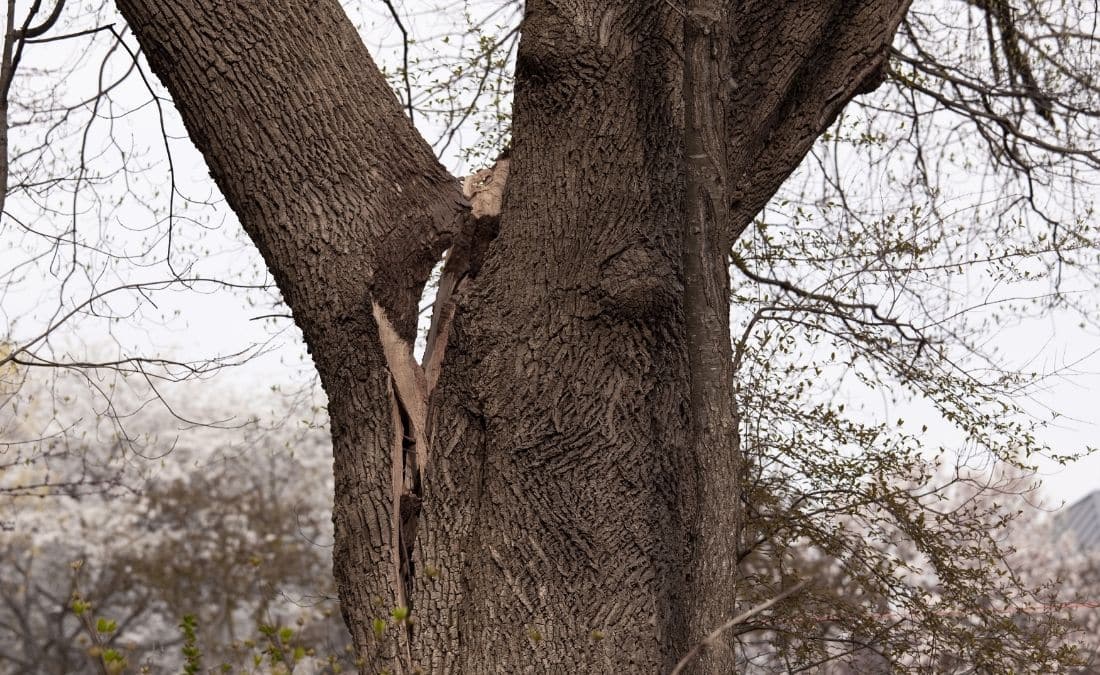
Have a damaged tree that needs saving? Here’s when cabling and bracing work, when targeted pruning helps, and when removal is the safer call after a storm.
Knowing how to save a damaged tree, or recognizing when it can’t be, is one of the more difficult decisions homeowners in Dallas County have to make. A sudden lean, vertical trunk crack, or heavy limb hanging over a roof all carry different risks, with respective options for addressing them. Waukee and Dallas Center homeowners face this decision frequently enough that it’s worth knowing how arborists go about it.
In Iowa, the stakes are clear, especially when you factor in the August 2020 derecho that damaged trees on over 56,000 acres of state forest land and around 13% of urban canopy. With another storm season approaching, understanding how arborists inspect storm-damaged trees for stability, recovery potential, and failure risk becomes especially important.
Key Takeaways
- Not every leaning, split, or cracked tree needs to come down; however, not every one can be saved, either.
- Cabling and bracing reinforce structurally weak unions on otherwise healthy trees; they cannot fix root failure or advanced decay.
- Two practical guidelines help frame the decision: at least one inch of sound wood for every six inches of stem diameter, and no more than one-third bark loss around the trunk.
- Dallas County’s open exposure and aging canopy mean Waukee and Dallas Center homeowners are seeing more structural failures during storm season.
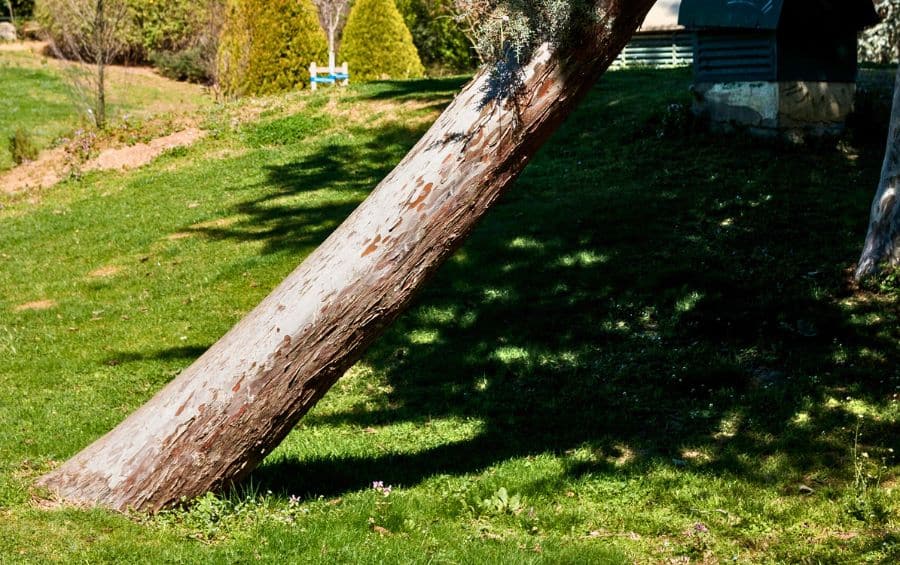
A sudden lean on a previously upright tree usually signals root failure — keep people and vehicles out of the fall zone until an arborist evaluates it.
How Do You Know If a Tree Is Structurally Compromised?
A tree is structurally compromised when visible defects (leans, splits, cracks at major branch unions, or heavy limbs over structures) change its load-bearing pattern in a way that increases the risk of failure. Some of these develop gradually over years, while others can appear overnight. Regardless, the symptoms tend to be visible from the ground if a homeowner knows what to look for. Most structural problems show themselves in one of many ways:
- A sudden lean, especially with soil heaving or roots lifted on the opposite side (which usually means root failure)
- A vertical crack running down the trunk or through a major branch union
- A V-shaped union with bark pinched into the joint, called included bark
- A heavy limb extended over a roof, driveway, or play area
- Co-dominant stems (two trunks of similar diameter forking from a single point)
- Mushrooms or fungal conks at the base or along the trunk
When a Defect Is an Emergency
Some of these signs can wait for a scheduled inspection, while others cannot. A sudden lean from a tree that was previously upright likely means the root system has given way. If that’s the case, keep people and vehicles out of the fall zone until it is evaluated by an arborist.
A crack you can see daylight through, or one that has visibly widened since your initial noticing, is of an equal level of urgency. The same can also be said about a partially detached limb hanging in the canopy, which arborists refer to as “hangers.”
Symptom recognition is always the first step. After that, it’s about figuring out what to do about it.
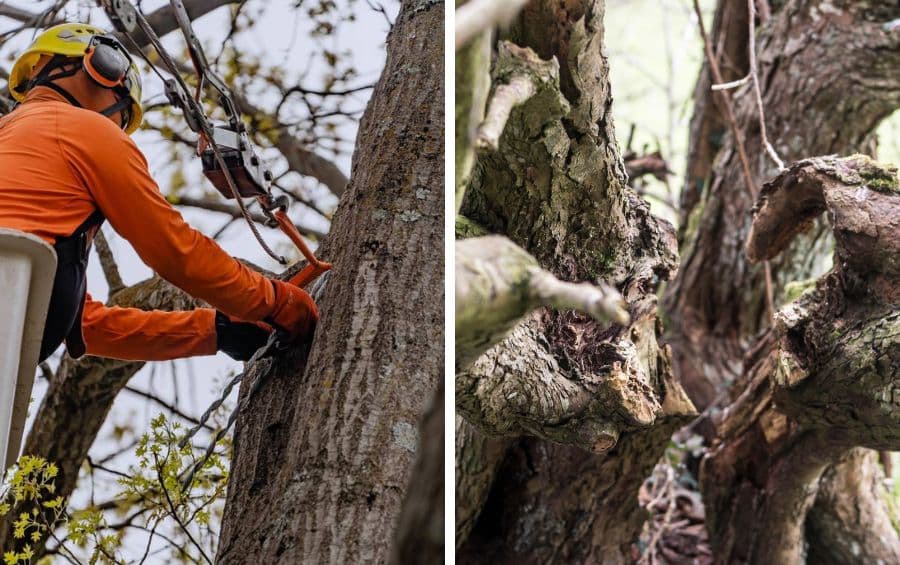
Left: an arborist installs support hardware high in the canopy. Right: the kind of failed codominant union that cabling, installed in time, is designed to prevent.
Can a Structurally Damaged Tree Be Saved?
Sometimes—but the answer depends on the type of damage and how much structural strength the tree still retains. A cracked limb after a storm is very different from a trunk split, root plate failure, or advanced internal decay.
Many structurally damaged trees can remain standing safely for years with proper risk reduction and monitoring. Others become hazardous immediately because the defect affects the tree’s ability to support its own weight.
The challenge is that structural problems are not always visible from the ground. Trees can continue leafing out normally while major weaknesses develop inside the trunk, root flare, or branch unions. That’s why arborists evaluate both the visible defect and the amount of sound wood still supporting the tree before recommending preservation or removal.
How Do Arborists Decide Whether a Damaged Tree Can Be Saved?
Arborists weigh three possible paths for a structurally compromised tree:
- Supporting it with cables and braces
- Reducing risk through pruning
- Removing it
The right choice depends on how much sound wood remains, where the defect is located, whether the damage is stable or worsening, and what the tree could strike if it fails. Each option has structural thresholds that help determine whether the tree can be reasonably preserved or has become too compromised to remain safely standing.
1. Cabling and Bracing
Cabling and bracing work best when a union is mechanically weak (V-crotch, included bark, included crack), but the wood around it is otherwise sound. The tree also needs to have meaningful useful life left and high-value targets nearby, like a house or driveway. For co-dominant stems, the UMass Urban Tree Lab suggests looking for at least one inch of sound wood for every six inches of attached stem diameter.
2. Restoration Pruning
When the defect is moderate, removing weight from heavy limbs lowers the lever arm acting on the weak union and reduces the probability of failure without any hardware at all. Pruning for reducing risk is typically paired with cabling for layered protection.
3. Safe Removal
Tree removal becomes the right call when the wood itself is gone. Iowa State University’s threshold is straightforward. If more than a third of the bark is missing around the trunk, the tree should come down. Severe trunk splits, advanced decay at the union, and sudden leans from root failure are all in the same category. Cables can’t fix root problems; once the foundation lifts, the tree’s anchor is gone.
Why Storm-Damaged Trees Need Ongoing Evaluation
Trees in Dallas County face a combination of conditions that increase structural stress over time:
- High wind exposure
- Recurring severe weather events
- A maturing canopy
The geography works against them. Dallas County sits on Iowa’s open western prairie edge, where sustained wind loads are often higher than in neighborhoods buffered by older Polk County tree cover. That repeated exposure can gradually worsen existing cracks, weak unions, and storm damage that may have initially seemed minor.
Increased Storm Exposure
Over the past six years, the pattern has not favored Iowa’s canopy. The state has experienced three derechos since 2020, along with repeated tornado outbreaks and severe wind events across central Iowa. Ice loading remains another ongoing concern, capable of multiplying a branch’s effective weight many times over during winter storms.
That ongoing exposure is part of why arborists evaluate not just the visible damage itself, but also how future wind, ice, and canopy stress are likely to affect the tree’s long-term stability.
Two Towns and Two Different Risk Profiles
Waukee and Dallas Center share a county and a corridor along Highway 44, but their canopies have different stories:
- Dallas Center: Trees planted in the 1950s through the 1970s are now 50 to 70 years old, peak structural-defect age. Silver maple, common in plantings of that era, is a species ISU specifically notes as susceptible to wind damage and breakage as it matures.
- Waukee: The 1990s subdivisions that built out the city were heavily planted with fast-growing species, like silver and Norway maples and callery pears, that have now reached the size where co-dominant stems become genuine failure risk instead of future ones.
Frequently Asked Questions About Saving a Damaged Tree
How can you tell if a leaning tree is dangerous?
A lean that has suddenly appeared, especially with soil heaving or roots visibly lifted on the opposite side, is a sign of root failure and is usually dangerous. A tree that has always leaned and shows no recent change is typically less concerning, but any new movement warrants a professional assessment.
Can a damaged tree always be saved?
No. Whether you can save a damaged tree depends on what kind of damage is present and how much sound wood remains. Trees with structurally weak unions and intact wood are generally candidates for cabling and bracing. Trees with the following generally need to come down:
- Root failure
- Severe trunk splits
- More than one-third bark loss
Can cabling save a split tree?
Sometimes. If the split is at a structurally weak union and there’s still adequate sound wood around it, cabling combined with a bracing rod can stabilize the union. If the split runs deep into the trunk and the wood around it is decayed, removal is generally the safer option.
What does it mean when a tree has two trunks?
Two trunks of similar diameter forking from a single point are called co-dominant stems. They’re weaker than a single dominant trunk because the union between them often contains included bark, which prevents the wood from fusing properly and creates a built-in failure point.
How long does cabling and bracing last?
Cables and braces can remain effective for many years, but they’re not permanent. Annual inspections are part of any properly installed system because:
- Trees keep growing
- Hardware wears
- Storms can damage installations
What trees are most at risk in Iowa storms?
In central Iowa, trees that are among the most vulnerable include:
- Silver maples
- Norway maples
- Callery pears
- Aging ash trees with EAB pressure
Fast-growing species and trees with co-dominant stems generally fail before slower-growing species with single dominant trunks.
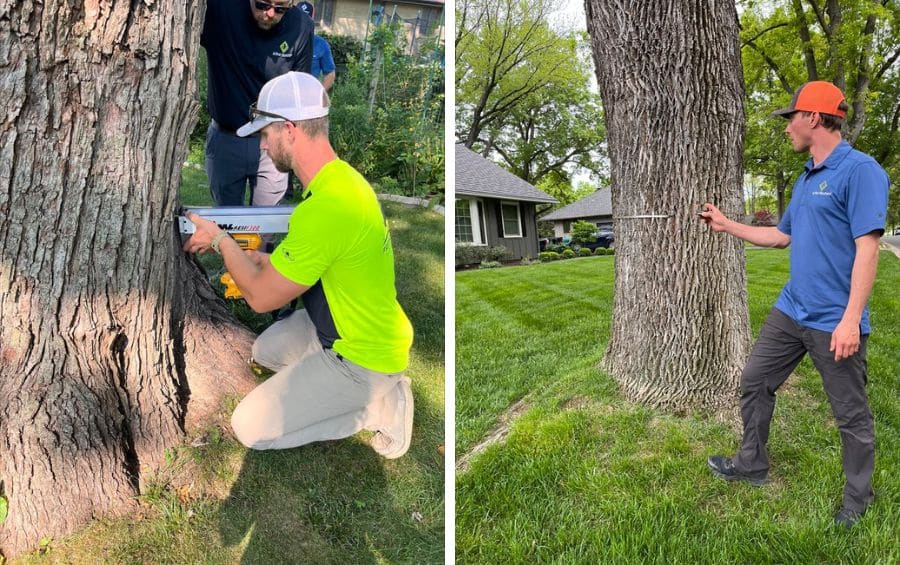
An on-site assessment goes well beyond a glance from the truck — Arbor Masters arborists use drill-resistance testing and trunk measurements to evaluate sound wood and structural risk objectively.
Contact Arbor Masters for Your Damaged Dallas County Trees
A structurally damaged tree is not always a removal candidate, but it should never be ignored. Cracks, weak unions, storm damage, and developing leans all have different levels of risk, and the safest solution depends on how much sound wood remains, where the defect is located, and what the tree could strike if it fails.
For homeowners in Waukee and Dallas Center, the most important step is having the tree evaluated before additional wind, ice, or storm loading turns a manageable defect into a major structural failure. An Arbor Masters arborist can assess the damage, explain the level of risk present, and recommend whether the tree can be preserved safely or should be removed before the next round of severe weather arrives.
Schedule an on-site evaluation with Arbor Masters’ Des Moines team by calling 515-218-2025 or requesting a quote online.

Want More Like This?
Get the latest local news, tree care tips, special offers, and company updates directly to your inbox! It's easy to subscribe and there's no spam - we promise.
"*" indicates required fields
