
How to Identify and Stop Apple Scab on Crabapples
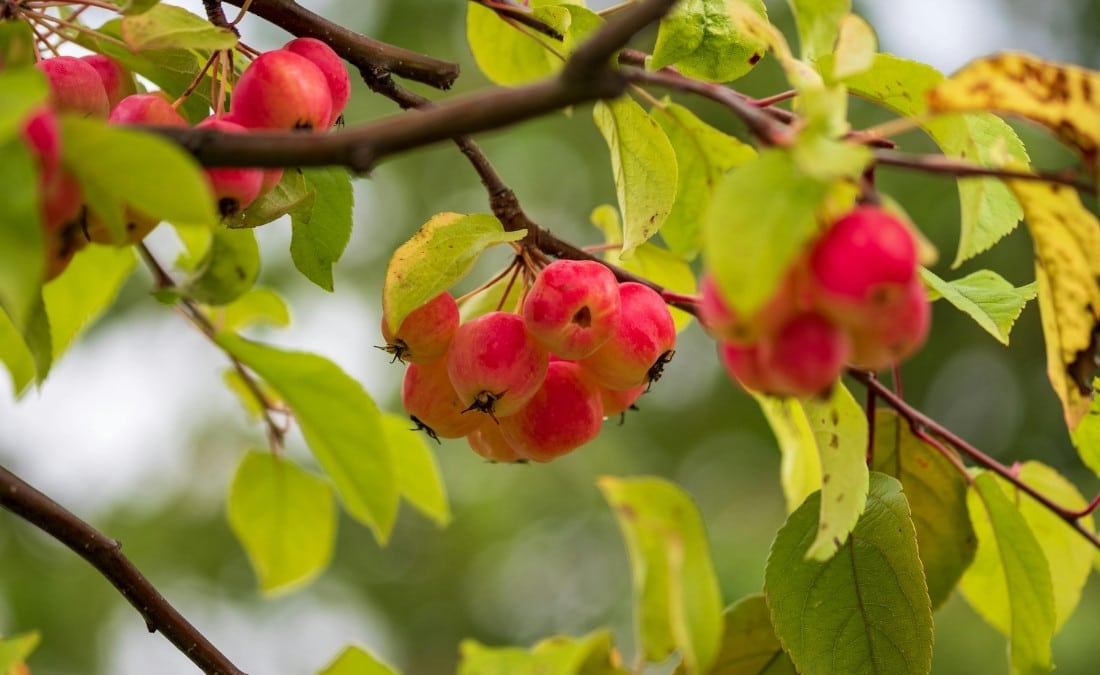
Seeing olive-green spots and falling leaves on your crabapple? It's likely apple scab. Here's what those spots mean and how to stop them next year.
Many older Marion neighborhoods were planted with crabapple varieties that predate modern disease-resistant cultivars. During cool, wet Iowa springs, those mature trees become especially vulnerable to apple scab, one of the region’s most common ornamental tree diseases.
Whether the problem appeared suddenly this year or has become a recurring frustration on an older crabapple, understanding how apple scab spreads and develops is the first step toward managing it effectively.
Key Takeaways
- Apple scab causes olive-green to brown spots on crabapple leaves followed by yellowing and premature leaf drop, often by mid-summer.
- The fungus overwinters in fallen leaves and reinfects new growth every spring, which is why scab returns year after year on the same tree.
- Once you can see spots, fungicide cannot cure the existing infection—protection has to start at bud break the following spring.
- A professional plant health care program built around spring timing is the most reliable way to break the cycle on Marion’s mature crabapples.
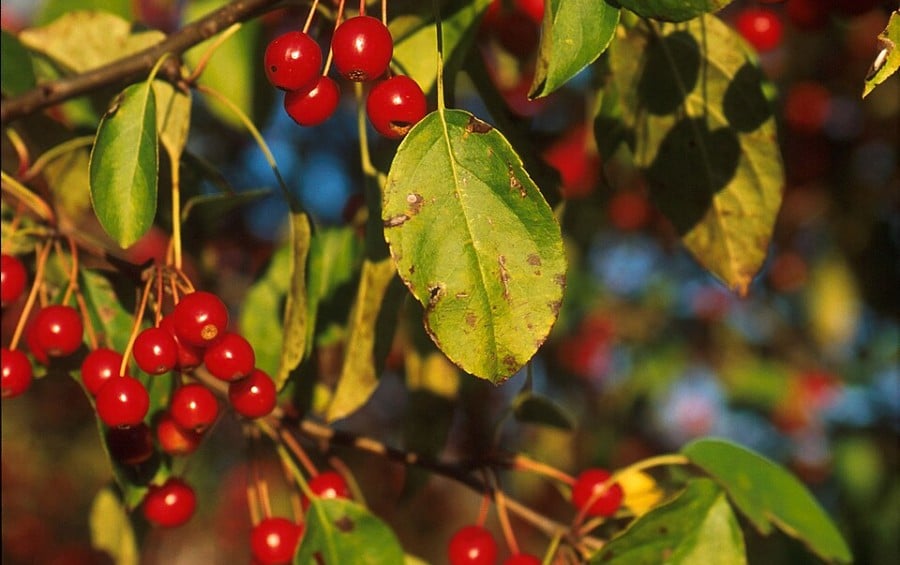
The brown lesions with feathery edges are classic apple scab. By the time spots are this visible, the year’s infection cycle is well under way.
What Does Apple Scab Look Like on a Crabapple?
Apple scab shows up as olive-green to brown velvety spots with feathery edges on crabapple leaves, usually followed by yellowing and premature leaf drop by mid-summer. The pattern is distinctive enough that once you know it, you’ll spot it from across your yard.
Here’s what gives apple scab away on a crabapple:
- Olive-green to brown spots, sometimes darkening to black as they age.
- Feathery, irregular margins around each spot—not the sharp, clean edges you’d see with mechanical or chemical damage.
- Clusters of spots along the leaf veins, appearing on both upper and lower leaf surfaces.
- Yellowing of heavily infected leaves, followed by drop, sometimes leaving the canopy noticeably thin by mid-summer.
- Corky, cracked lesions on any fruit present, with early fruit drop.
How to Tell Apple Scab from Cedar-Apple Rust
Apple scab and cedar-apple rust are two of the most common fungal diseases affecting Iowa crabapples, and homeowners frequently confuse them. The easiest way to tell them apart is by the leaf spots themselves. Cedar-apple rust produces bright yellow-orange spots that become more vivid as the season progresses, while apple scab causes darker olive, brown, or velvety-looking lesions.
Apple scab is also far more likely to cause significant midsummer leaf drop on susceptible crabapple varieties. Trees struggling with heavy defoliation by early or midsummer are often dealing with scab pressure rather than rust alone. A Certified Arborist can confirm the diagnosis as part of insect and disease control services.
Why Does Apple Scab Come Back Every Year?
Apple scab returns every year because the fungus overwinters in fallen infected leaves on the ground, then releases spores in spring that reinfect new growth as buds open. The cycle is consistent, and breaking it is the main objective of professional treatment.
The Fungal Lifecycle
The pathogen behind apple scab is a fungus called Venturia inaequalis, the same one that infects edible apples in commercial orchards. It survives Iowa winters tucked into the layer of dead leaves underneath your crabapple. In early spring, as buds swell and new leaves emerge, the fungus releases ascospores into the air. Those spores ride wind currents and rain splashes up in the canopy, landing on tender new leaves.
Spores need several hours of leaf wetness to infect emerging leaves. From there, the fungus produces a second wave of spores that continue spreading through the canopy during wet weather events all summer long. According to Iowa State University, that repeating cycle of reinfection is what allows apple scab to intensify so quickly on susceptible crabapple varieties during cool, rainy springs.
When Is It Too Late to Treat Apple Scab?
Once you can see spots on the leaves, fungicide will not cure the existing infection, and the meaningful treatment window for this year is already closed. This can be frustrating for many homeowners, but understanding why makes next year’s plan easier.
Why Visible Symptoms Mean the Window Has Passed
Apple scab fungicides are protective, not curative. They work by coating new leaf tissue with a chemical barrier that prevents incoming spores from germinating. They can’t kill fungi that have already established themselves inside the leaf. In Iowa, the vital spray window starts at what arborists call the “half-inch green tip” stage of bud break. This usually falls in the first week of April in the Marion and Cedar Rapids area.
Effective preventive treatment continues at seven-to-fourteen-day intervals through bloom and petal fall.
What You Can Do Right Now
Panic-spraying the tree will not help it, and incorrectly rotating products can build fungal resistance. Instead, focus on canopy preservation, such as:
- Watering deeply during dry stretches
- Avoiding added stress like soil compaction or root damage
- Skipping any late-summer pruning that opens fresh wounds
Rake and remove fallen leaves throughout the season, especially in the autumn, since they’re the source of next year’s infection. Then, get on a Certified Arborist’s calendar now for an early-spring treatment plan. The team at Arbor Masters of Cedar Rapids builds the spring schedule months in advance.
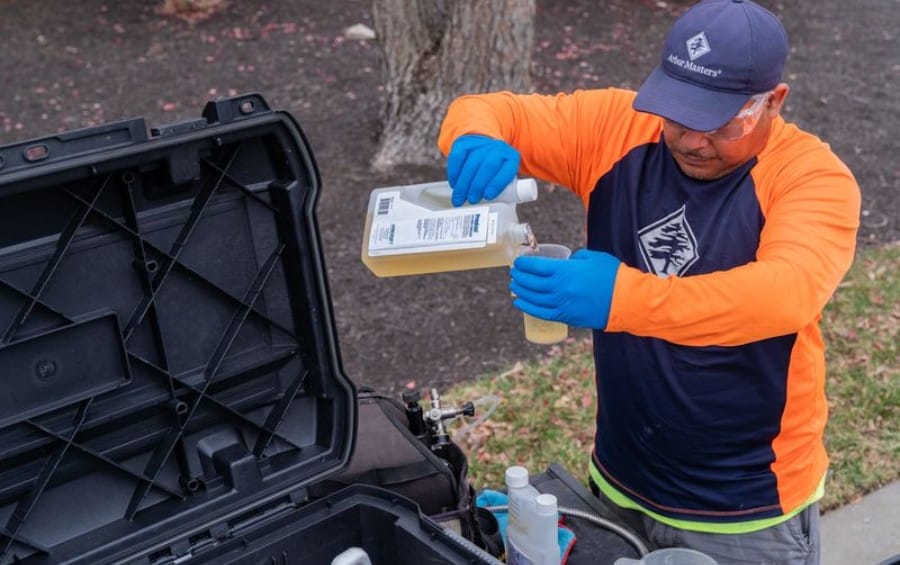
Certified Arborists and trained PHC technicians use calibrated mixing, proper PPE, and rotating active ingredients to keep treatments effective and safe.
How Does a Plant Health Care Program Prevent Apple Scab?
A plant health care program (PHC) prevents apple scab by applying protective fungicide treatments at strategically timed intervals starting at bud break, before the year’s first spores can infect new leaves. Timing is crucial, and getting it right is what separates a clean canopy in July from a tree that’s lost half its leaves.
What’s Included in a Crabapple PHC Program
A standard crabapple PHC program from Arbor Masters covers:
- Site assessment by a Certified Arborist to confirm apple scab and rule out lookalikes like cedar-apple rust, fire blight, or environmental stress.
- First fungicide application at half-inch green tip, typically the first week of April depending on the spring.
- A follow-up application through bloom and petal fall—in Iowa, two well-timed treatments are often enough on ornamental crabapples.
- Active ingredient rotation across multi-year programs to prevent fungal resistance.
- Systemic trunk-injection options for very large or mature trees where ground-based canopy spray isn’t practical.
Should You Treat Your Crabapple Every Year, or Replace It?
Whether to treat or replace a chronically scabby crabapple depends on:
- The cultivar
- The tree’s age
- The value of your property
- How severe the recurrence has been
For some trees, annual treatment is worth it. For others, the numbers are harder to justify.
The Variety of Crabapple Often Determines the Best Long-Term Option
Crabapple cultivars span a wide range when it comes to scab resistance. Older varieties like “Hopa,” “Radiant,” “Royalty,” and “Spring Snow” are notoriously susceptible and tend to defoliate badly every wet spring.
Scab-resistant cultivars like “Prairifire,” “Adirondack,” and “Donald Wyman” weren’t widely planted in Iowa landscapes until the ’90s and 2000s, which is why Marion and Hiawatha neighborhoods built between the ’60s and ’90s have so many susceptible crabapples.
When Annual Treatment Makes Sense
Annual treatment is typically the right call when:
- The tree is mature, structurally sound, and a significant feature of your landscape.
- It survived the 2020 derecho and has decades of growth ahead—surviving mature trees in Cedar Rapids are increasingly rare and worth protecting.
- The owner values consistent bloom and a full canopy each spring and summer.
- A Certified Arborist consultation confirms that long-term treatment costs make sense relative to the tree’s value to the property.
For a chronically declining tree on its last legs, tree preservation services can help you decide where the line falls between worth saving and time to move on.
Frequently Asked Questions About Apple Scab on Crabapple Trees
Can apple scab kill my crabapple tree?
Apple scab rarely outright kills a crabapple, but repeated annual defoliation weakens the tree and makes it more vulnerable to:
- Winter injury
- Secondary pests
- Overall decline
A consistently scabby tree that loses half its leaves every summer will decline noticeably over five to ten years.
Will raking up the leaves stop apple scab?
Sanitation helps, but it won’t eliminate the problem on its own. Removing fallen leaves before snow falls can lower the spore load on your property, but spores can blow in from neighboring crabapples, hawthorns, or mountain ash. Treat sanitation as a meaningful supplement to fungicide treatment, not a replacement for it.
Does apple scab spread to other trees in my yard?
Apple scab only infects plants in the rose family (Rosaceae), which includes:
- Crabapple
- Apple
- Pear
- Hawthorn
- Mountain ash
- Cotoneaster
It will not spread to your maple, oak, or other landscape trees, but a single infected crabapple can spread spores to other susceptible hosts nearby.
Is it safe to compost apple scab leaves?
Only if your compost pile reaches sustained high temperatures, which most home piles don’t. The safer options are:
- Bagging leaves for municipal yard waste pickup
- Burning where permitted
- Burying them away from susceptible trees
Leaving infected leaves under the tree all winter guarantees reinfection next spring.
Why does my neighbor’s crabapple look fine while mine has scab?
Crabapple cultivars vary greatly in their susceptibility to scab. Your neighbor likely has a disease-resistant cultivar planted in the last two or three decades, while yours may be an older variety that’s extremely susceptible. A Certified Arborist can help identify the cultivar and recommend whether annual treatment is the right call.
How much does apple scab treatment cost?
Treatment costs depend on:
- Tree size
- Accessibility
- The number of applications needed
- Whether canopy spray or trunk injection is the right approach
A consultation with a Certified Arborist will produce a tailored estimate based on your specific tree and property.
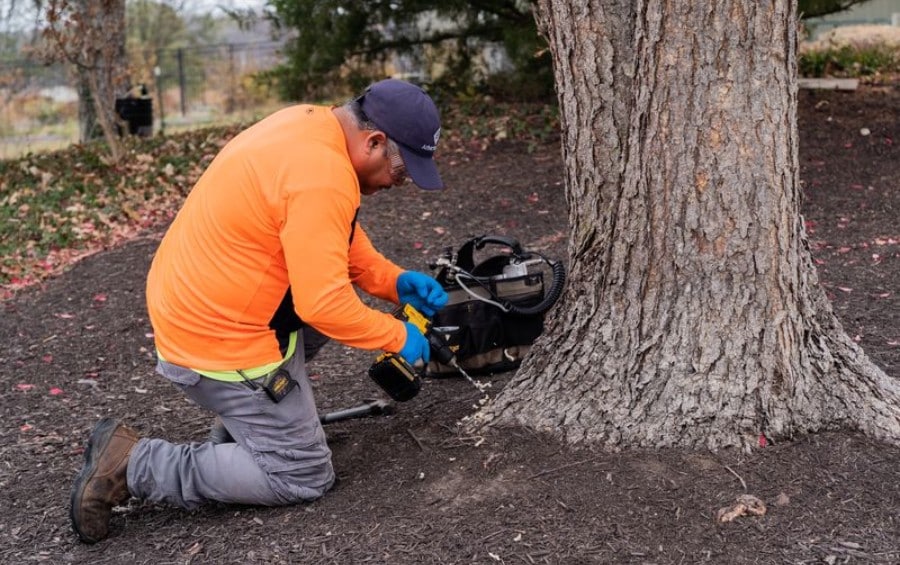
Trunk injection delivers fungicide directly into the tree’s vascular system—a practical option for very large or mature crabapples where ground-based canopy spray isn’t feasible.
Get Ahead of Next Spring’s Apple Scab with Arbor Masters
Marion’s mature crabapples are worth preserving. Many anchored neighborhoods throughout the 2020 derecho and still bring spring color to streets that lost so much canopy. Get a free quote from a Certified Arborist at Arbor Masters of Cedar Rapids now to get on the spring health care schedule before spring is fully booked. Call 319-359-6135 today.
Want More Like This?
Get the latest local news, tree care tips, special offers, and company updates directly to your inbox! It's easy to subscribe and there's no spam - we promise.
"*" indicates required fields
