Why Are My Tree’s Leaves Turning Yellow? A Diagnostic Guide for Eastern OKC Homeowners
Yellow leaves on your Midwest City or Del City tree? Learn the visual pattern that reveals the cause, from iron chlorosis to pest damage & what to do about it.
If you’re wondering why your tree leaves are turning yellow in Oklahoma, you’re dealing with one of the most common late-summer questions for homeowners across Midwest City, Del City, Choctaw, and Shawnee. August is peak yellow-leaf panic season, when Oklahoma County’s clay soil, summer heat, and pest pressure all converge on the same trees at once.
The pattern of the yellowing, not just the fact that it’s happening, can help narrow down the cause. Compare what you’re seeing with these five common patterns to identify the likely problem and what to do next.
Key Takeaways
- The pattern of yellowing, whether it appears between the leaf veins, across the whole canopy, along the edges, in spots, or on isolated branches, is the fastest way to narrow down the cause.
- Iron chlorosis can occur when high soil pH limits iron availability, but soil pH varies across eastern Oklahoma County, so test the soil before treating for an iron deficiency.
- Environmental leaf scorch can look similar to bacterial leaf scorch, a much more serious disease, so getting the identification right matters.
- If you can’t confidently match your tree’s pattern to one cause, a professional diagnosis saves you from wasting time and money on the wrong fix.
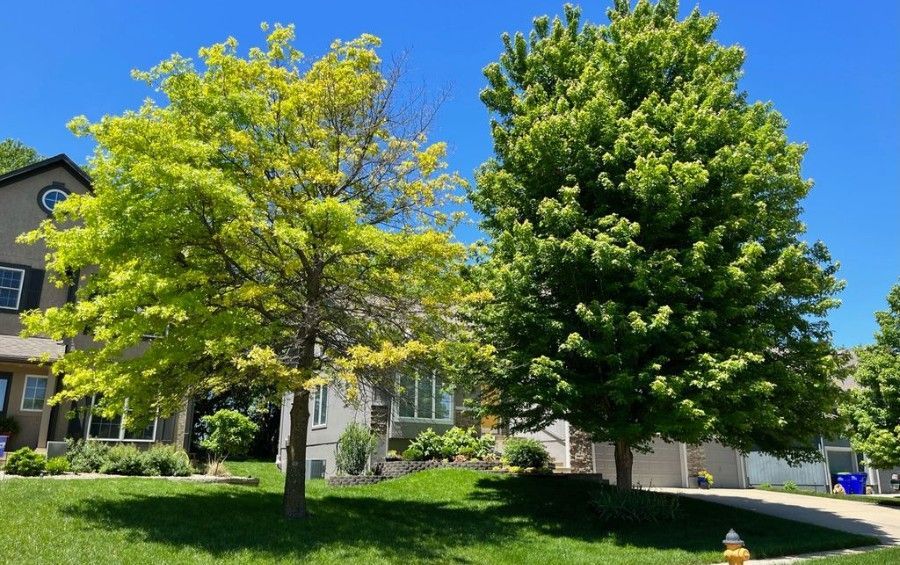
Comparing a tree with iron chlorosis (left) to a healthy tree (right) makes the widespread yellowing caused by nutrient deficiency easy to spot.
5 Common Reasons Tree Leaves Turn Yellow in Oklahoma
Yellow leaves can point to several different problems, including nutrient deficiencies, water stress, leaf scorch, fungal disease, and pest damage. The way the yellowing appears on the tree can help you tell these causes apart.
Start by comparing what you’re seeing to the common symptoms below. Keep in mind that symptoms can overlap, and a tree may be dealing with more than one issue at the same time.
| Yellowing patterns | Possible causes |
| Yellow between the veins, veins stay green | Iron chlorosis |
| Whole canopy yellow or wilting at once | Water stress |
| Brown or yellow edges, green center | Leaf scorch |
| Spots or blotchy patterns | Fungal disease |
| Only some branches or leaves affected | Pest damage |
Are Your Tree’s Leaves Turning Yellow Between the Veins?
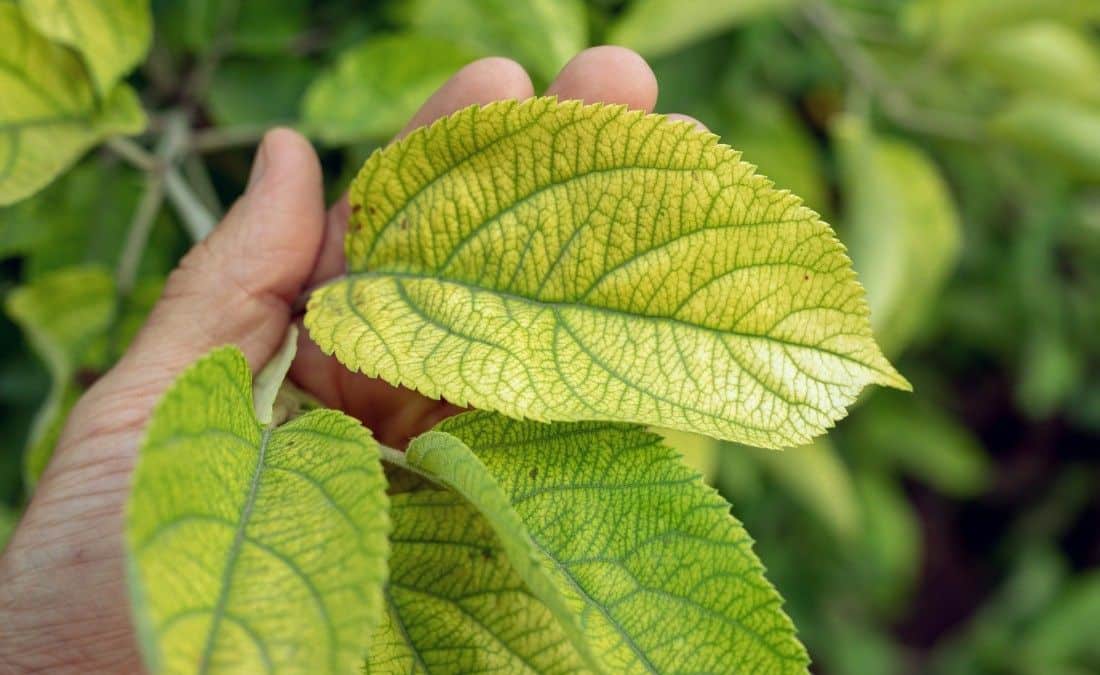
Yellow tissue between the leaf veins, while the veins themselves stay green, points to interveinal chlorosis. This pattern can be caused by iron deficiency or other nutrient-uptake problems, and occurs most commonly when high soil pH limits nutrient availability. However, soil pH varies considerably across Oklahoma landscapes, so don’t assume alkaline conditions without testing.
What Iron Chlorosis Looks Like
- Yellowing often begins on newer leaves.
- Veins remain noticeably greener than the surrounding leaf tissue.
- In more severe cases, leaves may turn pale yellow or nearly white, develop brown areas, or drop prematurely.
Why Iron Chlorosis is Common in Oklahoma Landscapes
Interveinal chlorosis can develop when soil pH rises high enough to limit iron availability, or when other conditions impair nutrient uptake, such as compaction, poor drainage, or excess phosphorus. Clay soils can be particularly prone to compaction and drainage issues that interfere with root access to nutrients.
Soil testing is the only way to confirm whether iron deficiency, another nutrient limitation, or a root-access problem is causing the yellowing. See our full guide to iron chlorosis treatment for soil testing and treatment options for Oklahoma trees.
Is Your Tree’s Whole Canopy Turning Yellow at Once?
Uniform yellowing or wilting across much of the canopy often indicates water stress. This pattern shows up most often during OKC’s hottest stretches in July and August. However, both drought and waterlogged roots produce similar-looking symptoms, so you need to check soil moisture before adjusting your watering.
What Water Stress Looks Like
- The yellowing and wilting appear evenly across the tree rather than in scattered patches.
- Leaves may droop or curl during the hottest part of the day and recover somewhat overnight. This is a pattern that can suggest water stress, though other conditions can produce the same symptom
- There are no spots and no isolated branches involved, which sets it apart from disease or pest damage.
Why Both Overwatering & Underwatering Cause Similar Symptoms
Both too little water and too much water produce a similar-looking uniform yellow wilt, since a tree with waterlogged roots struggles to take up water just as much as a tree in drought. That overlap is what makes water stress tricky to diagnose on your own. Before changing your watering routine, check the soil moisture rather than guessing.
What to Do When You Spot Water Stress
- Water deeply and infrequently to soak the root zone rather than watering quickly every day.
- Remember that eastern Oklahoma County’s clay soil holds water longer than it appears to on the surface.
- Expect good recovery potential if you catch the stress early and adjust watering before the season’s peak heat passes.
Are Your Tree’s Leaves Turning Yellow and Brown at the Edges?
Leaf edges that turn brown or yellow first, while the veins and interior tissue hold their color longest, indicate leaf scorch. This pattern develops when water loss from leaves exceeds the tree’s ability to replace it. Leaf margins and tips are often the first areas to show injury.
The Leaf Scorch Pattern
- The edges brown or yellow first, and the discoloration works inward over time rather than appearing across the whole leaf at once.
- Leaf margins and tips are often the first areas to show injury because they’re farthest from the water-transport tissues in the veins and are the first to lose water when supply can’t keep up with demand.
- Scorch is usually tied to a root system that can’t keep up with the tree’s water demands, whether from drought, damage, or restriction.
What Causes Environmental Leaf Scorch?
- Drought stress that leaves the root system unable to meet the canopy’s water demand.
- Root restriction from nearby pavement or construction, which is common for trees planted near driveways and sidewalks.
- Overwatering, which can produce a similar scorched appearance despite the opposite cause.
Existing scorched tissue will not recover, but correcting the underlying water or root-zone problem can allow subsequent growth to develop normally.
Environmental Leaf Scorch vs. Bacterial Leaf Scorch
Environmental leaf scorch isn’t the only condition that produces this pattern. Bacterial leaf scorch is a far more serious, incurable disease first confirmed in Oklahoma on elm trees in 2004, and it has since been confirmed on oak, sycamore, and mulberry across the state, according to Oklahoma State University Extension.
If a mature shade tree develops scorch symptoms in late summer, it’s worth getting checked rather than assuming it’s just a watering issue. Learn the signs of bacterial leaf scorch to tell it apart from environmental causes.
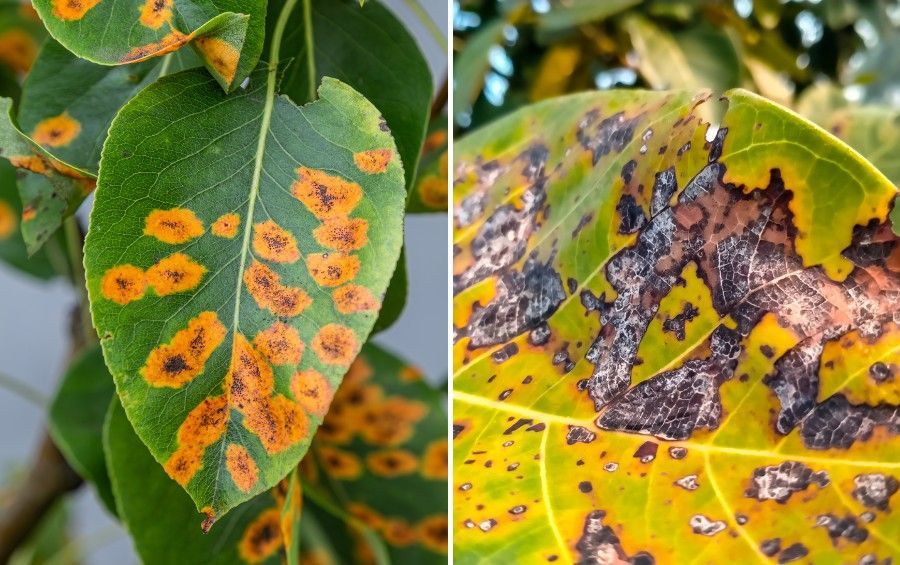
Spots, blotches, and irregular patches of discoloration are common signs of fungal leaf diseases such as anthracnose, rather than nutrient deficiency or heat stress.
Do Your Yellow Leaves Have Spots or Unusual Patterns?
Distinct spots or blotchy patches can point toward a leaf-spot disease, but fungi, bacteria, insects, and environmental injury can all produce overlapping visual patterns.
What Fungal Disease Looks Like
- Spots or blotchy patches instead of a uniform yellow color or a pattern confined to the veins
- Anthracnose and leaf spot are common culprits in the oak and elm canopy found throughout the eastern OKC corridor.
- Symptoms can appear on some leaves or branches while nearby ones look unaffected.
These symptoms need professional identification, since the right treatment depends on knowing which pathogen you’re dealing with and how far it has spread. See how to identify tree disease symptoms to confirm what you’re looking at.
Are Only Some Branches or Leaves Turning Yellow While Others Look Fine?
Yellowing limited to certain branches or parts of the canopy can indicate a localized problem rather than something affecting the entire tree. Sap-feeding insects, such as scale and aphids, are one possibility because their feeding can weaken affected leaves and branches without causing uniform symptoms throughout the canopy.
What Pest Damage Looks Like
- Small bumps or shell-like insects attached to twigs, branches, or leaves
- Leaves that curl, wilt, or appear distorted in addition to turning yellow
- Sticky residue on leaves, branches, cars, or surfaces beneath the tree
- Black sooty mold growing where honeydew has accumulated
Timing matters here more than with most of the other causes, since treatment windows for scale insects are narrow and tied to their life cycle. Check the treatment window for soft scale insects before it closes.
When Should You Call a Professional Arborist?
If your tree’s yellowing doesn’t clearly match one pattern above, or seems to match more than one, self-diagnosis turns into guesswork. Treating for the wrong cause doesn’t just waste time. It lets the tree continue declining while you address a problem it doesn’t actually have.
It may be time for a professional assessment if:
- The yellowing doesn’t clearly match one of the patterns above.
- Symptoms seem to point to more than one possible cause.
- Yellowing continues to spread or worsen despite changes you’ve made.
A Certified Arborist can confirm the true cause with an on-site assessment and recommend a treatment plan suited to your tree’s actual condition, whether that means a soil amendment, a watering adjustment, or a targeted pest or disease treatment.
Frequently Asked Questions About Leaves Turning Yellow
Can yellow leaves turn green again?
Leaves that have already turned yellow typically won’t turn green again, but new growth can come in healthy once you correct the underlying cause.
Is it normal for oak trees to drop yellow leaves in summer?
Some premature yellowing and leaf drop can occur during periods of heat or drought, but heavy, sudden, or repeated summer defoliation deserves a thorough assessment.
How do I know if my soil needs water before I adjust my watering schedule?
Push a finger or a screwdriver a few inches into the soil near the root zone. If the soil feels dry at that depth, the tree may need water. If it’s still moist, hold off on watering and consider drainage, root, nutrient, disease, or pest issues instead.
Is my yellowing tree dying?
Not necessarily, but a few signs point to something more serious than the causes in this guide, including progressive branch dieback, significant trunk cracks or cavities, extensive bark loss, or fungal fruiting bodies associated with decay.
Do fall colors count as yellowing leaves?
No. Natural fall color follows the tree’s normal seasonal timing, while stress-related yellowing often appears prematurely or in conjunction with other symptoms.
Can more than one cause affect my tree at the same time?
Yes, and it’s common. A tree already stressed by heat or drought has less energy to fend off pests and disease, so it’s not unusual to see two patterns overlapping on the same tree.
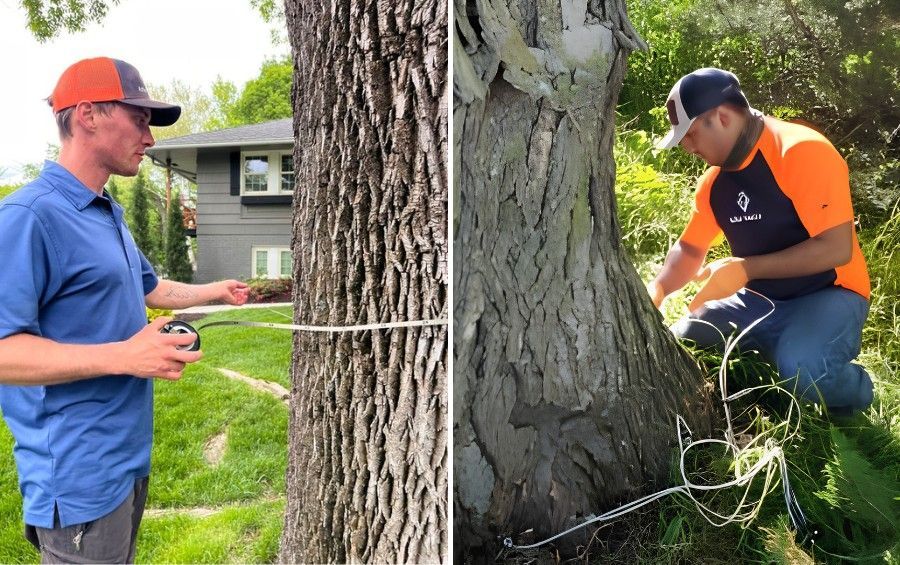
When yellowing leaves don’t clearly match one pattern, a professional tree inspection can identify the underlying cause and recommend the right treatment.
Still Not Sure What’s Wrong With Your Tree?
Yellow leaves don’t automatically mean your tree is dying. More often, they’re your tree’s way of signaling that something needs attention. By matching the pattern of the yellowing to the most likely cause, you’ve already taken the first step toward solving the problem instead of guessing.
If your tree doesn’t clearly fit one pattern, or several symptoms overlap, an Arbor Masters Certified Arborist can identify the underlying cause and recommend the right treatment before a manageable issue becomes a long-term problem. Call Arbor Masters OKC at 405-302-8118 or request a free assessment today.
Learn More With These Related Articles


Want More Like This?
Get the latest local news, tree care tips, special offers, and company updates directly to your inbox! It's easy to subscribe and there's no spam - we promise.
"*" indicates required fields