Why Is My Tree Turning Pale Yellow?
Tree leaves turning pale yellow with green veins in Cedar Rapids? See why alkaline clay soil causes iron chlorosis and which treatments work best this fall.
Across Cedar Rapids, many of the trees that’ve been planted since the 2020 derecho went into soil that lost its topsoil to storm cleanup and construction, which exposed the alkaline clay underneath. On those trees and older ones nearby, a certain symptom is showing up before fall color generally would have and has homeowners asking the same question: Why is my tree turning a pale yellow?
One possibility is iron chlorosis, a nutrient-availability problem commonly associated with alkaline soil.When left alone for a few years, it eventually causes branch and twig dieback in a tree that was otherwise healthy. When caught before significant decline, chlorosis can often be managed, although the best treatment depends on the species, soil conditions, and severity.
Key Takeaways
- Pale yellow leaves with green veins signal iron chlorosis, not normal fall color change.
- Cedar Rapids’ clay subsoil, often exposed where topsoil was removed for derecho-era replanting, is a leading local cause.
- Pin oak, river birch, and silver maple are among the species most susceptible in this area.
- Fall is a good time to diagnose and test the soil, while treatment timing depends on the product and method; spring is commonly recommended for soil-applied chelated iron, while professional trunk injection is generally performed around bud break.
- Burying iron nails or metal shavings near tree roots does not correct chlorosis in alkaline soil.
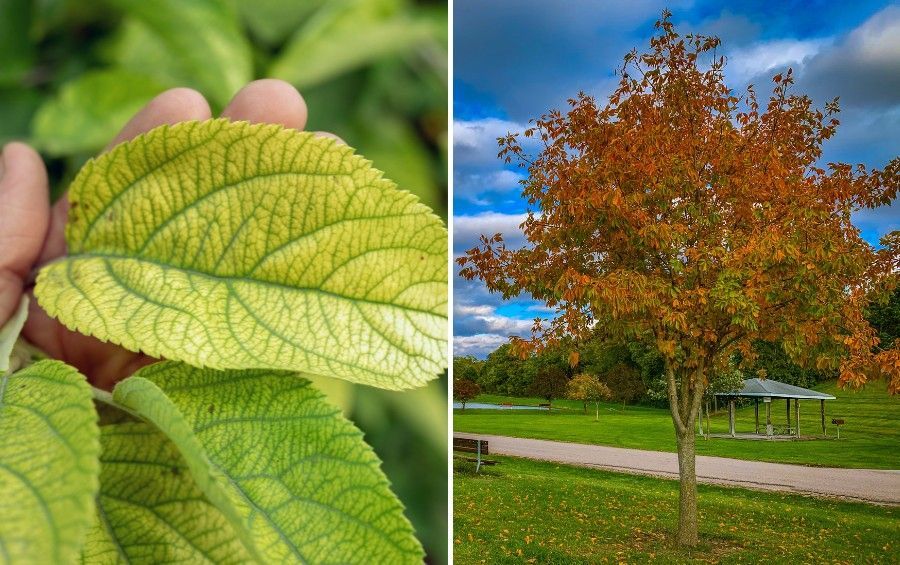
Interveinal yellowing, where the veins stay green and the rest of the leaf turns pale (left), looks different from a tree’s normal fall color change (right).
Is It Chlorosis or Just Fall Color?
Yellow leaves aren’t unusual as fall approaches, which can make early chlorosis easy to dismiss as a seasonal change. The difference is in how and where the yellowing develops. Fall color follows a tree’s normal seasonal pattern, while chlorosis creates distinct changes in the leaves and canopy that can persist or worsen over time.
Look for these differences:
- Chlorosis leaves stay green along the veins while the rest of the leaf turns pale yellow (interveinal yellowing).
- Normal fall color changes evenly across the whole leaf, following the tree’s usual seasonal palette.
- Chlorosis can affect much of the canopy or appear more strongly (in portions of the tree where root-zone conditions differ).
- In advanced cases, chlorosis causes leaf margins to scorch brown and curl.
- Left untreated for several years, chlorosis can lead to branch and twig dieback.
What Causes Iron Chlorosis in Cedar Rapids Trees?
Iron chlorosis is caused by a pH problem, not necessarily a shortage of iron in the soil. In Cedar Rapids, alkaline soil conditions can keep trees from accessing the iron that’s already there, and several local factors can make that problem worse:
- Soil pH above roughly 7.5 makes iron chemically unavailable for tree roots to absorb, even though the iron is present in the soil.
- Without accessible iron, a tree can’t produce enough chlorophyll to hold its leaf color.
- Exposed clay subsoil is a common trigger, especially in new housing developments where topsoil has been stripped away.
- Cedar Rapids’ derecho recovery has added another layer to the issue. Heavy tree loss led to large-scale replanting, including in yards where grading or previous construction had exposed alkaline clay.
And adding more iron isn’t necessarily the answer. Burying iron nails or metal shavings near the roots won’t correct the underlying pH problem. As the metal breaks down, alkaline soil chemistry can still keep that iron unavailable to the tree.
Before choosing a path for treatment, the fastest way to confirm the cause is a soil pH test, since chlorosis symptoms on a lot with neutral soil may point to a different problem, such as compacted roots or winter injury. That’s the window worth acting in before a mature tree needs more than a soil fix, which is why tree preservation in Cedar Rapids starts with catching chlorosis early.
Which Cedar Rapids Trees Are Most at Risk of Iron Chlorosis?
In Eastern Iowa, the species most commonly affected by iron chlorosis are:
- Pin oak
- River birch
- Silver maple
- Red maple
- Sweet gum
- Crabapple
If any of these species was planted in your yard within the last decade in Marion and the Cedar Rapids area, it should be watched closely every fall.
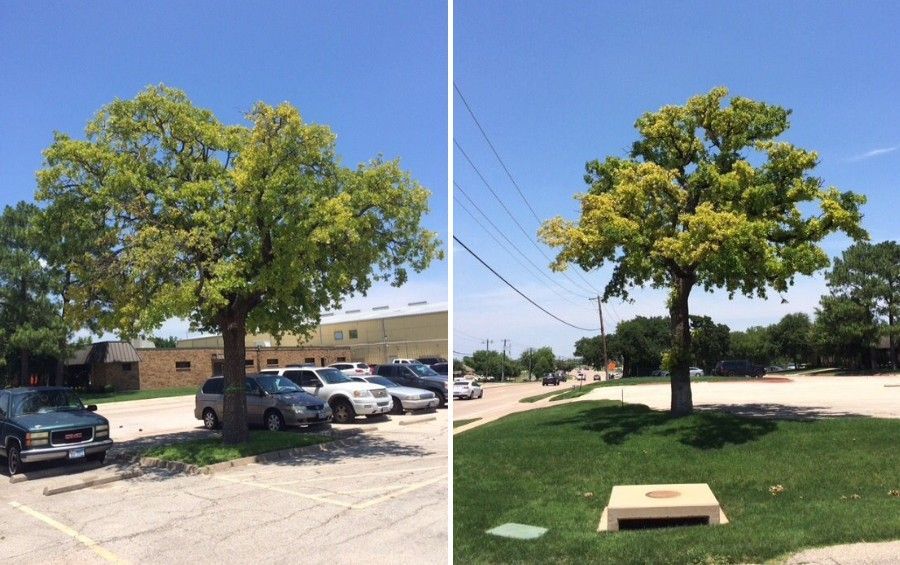
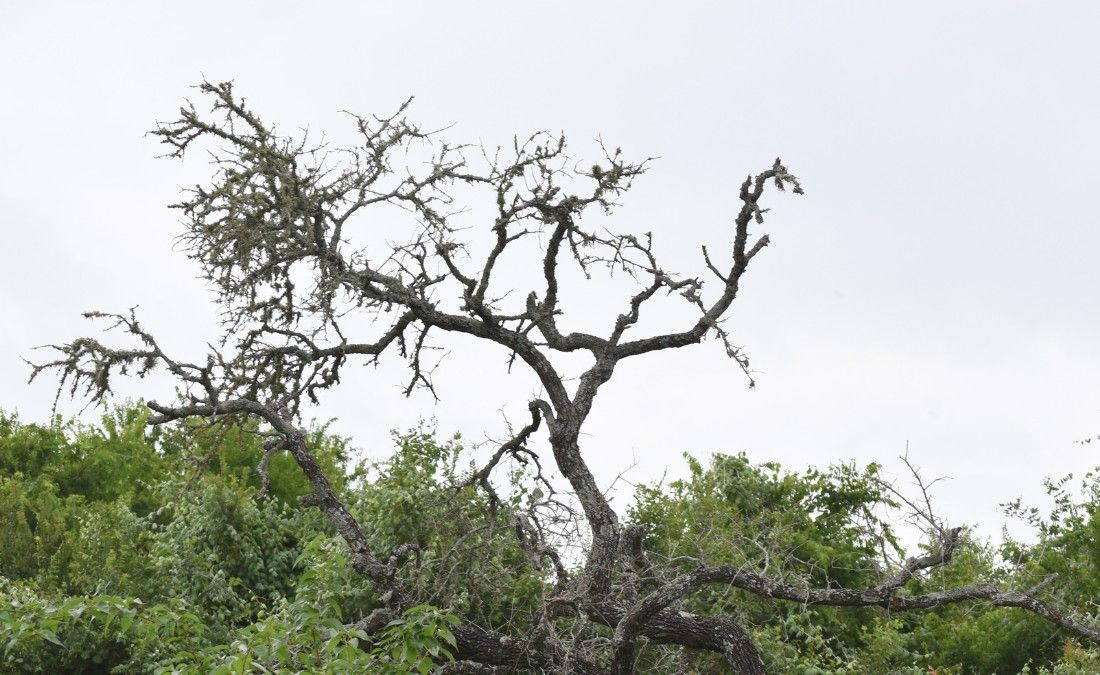
A pin oak showing the sparse, yellowing canopy typical of iron chlorosis.
How Is Iron Chlorosis Treated?
There isn’t one treatment that works for every chlorotic tree. Some options provide a quick improvement in leaf color, while others address iron availability in the soil or deliver iron directly to the tree for longer-lasting results. The right approach depends on the severity of the chlorosis, the tree’s condition, soil pH, and the time of year.
- Soil-Poured Iron Treatment : Iron applied to the soil can temporarily improve foliage color in some mildly chlorotic trees, although results may be inconsistent when high soil pH continues to limit iron availability. Unlike trunk injection, it isn’t tied to a narrow spring treatment window and can be applied in fall to begin addressing the problem before the next growing season.
- Leaf Sprays : Foliar iron produces the fastest visible green-up because it’s applied directly to the leaves, but the improvement is temporary and doesn’t correct the underlying soil problem. Sprays are generally used when chlorosis is visible during the growing season rather than on a specific seasonal schedule.
- Soil Acidifier : Sulfur, sometimes used with iron, helps lower pH around the root zone so the tree can better access iron that’s already in the soil. Because changing soil chemistry takes time, fall can be a useful window to begin treatment rather than waiting until yellow leaves return in spring.
- Trunk Injection : Iron is delivered directly into the tree through small holes in the trunk, bypassing the soil and providing a longer-lasting option for established trees with more significant chlorosis. Trunk injection is generally most effective around bud break in early spring, and treatments later in the growing season may not perform as well or last as long. Because injection wounds the trunk and requires the correct dose and placement, it should be performed by a qualified tree care professional.
The best approach depends on the tree’s species, size, soil conditions, and how far the chlorosis has progressed. A Certified Arborist providing Cedar Rapids plant health care and disease services can identify the underlying problem and recommend the treatment and timing that fit the tree.
Frequently Asked Questions About Leaves Turning Pale Yellow
Does chlorosis show up on the whole tree or just part of it?
Chlorosis often appears first on the side of the tree closest to disturbed soil or exposed clay, such as the side nearest a driveway, foundation, or graded area. As the deficiency progresses, it typically spreads to the rest of the canopy.
Can chlorosis spread to neighboring trees?
Chlorosis itself isn’t contagious. It’s driven by soil conditions, not a pathogen passed between trees. That said, neighboring trees planted in the same disturbed soil often develop symptoms around the same time, since they’re dealing with the same underlying clay and pH issue.
Are newly planted trees more at risk than established ones?
Yes. Younger trees have root systems that haven’t yet spread beyond the disturbed soil they were planted in, so they’re more exposed to the alkaline clay driving chlorosis. Trees planted within the last several years are worth checking each fall as a matter of routine.
Does mulching or fertilizing help with chlorosis?
General fertilization doesn’t address the pH-driven iron lockout and can sometimes make soil conditions worse. Mulching supports overall root health but isn’t a chlorosis treatment on its own.
Will iron chlorosis go away on its own without treatment?
No. Since chlorosis is driven by ongoing soil chemistry rather than a temporary condition, the yellowing will return each year until the underlying pH problem or the tree’s access to iron is directly addressed.
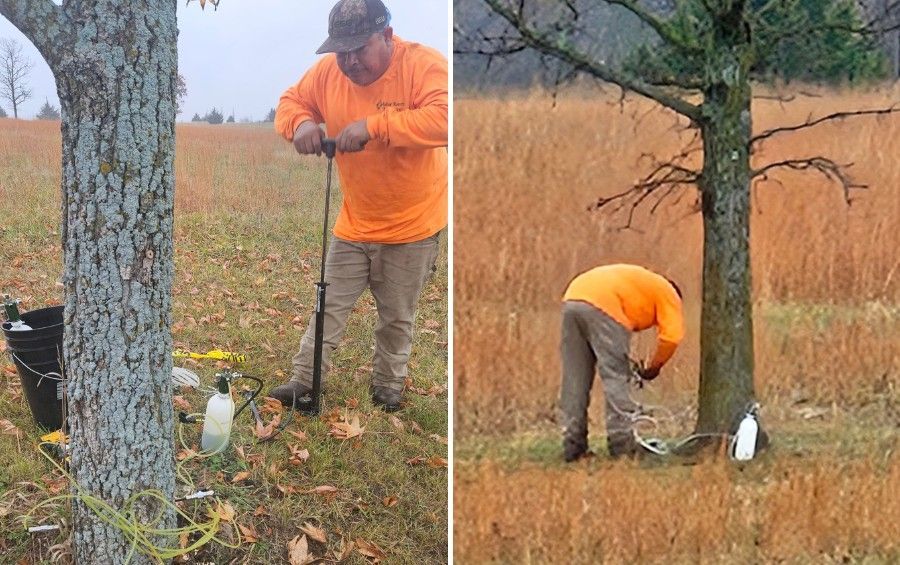
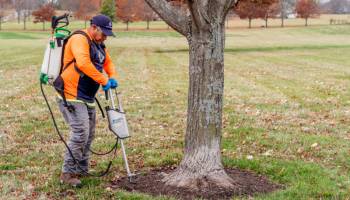
A Certified Arborist applies a soil-injected iron treatment to correct chlorosis before winter dormancy.
Don’t Let Iron Chlorosis Follow Your Tree Into Next Spring
Pale yellow leaves with green veins can be an early warning that your tree isn’t getting the iron it needs. Fall is a good time to find out why and determine what can be done now, what may need to wait until spring, and which treatment makes sense for your tree.
Schedule a plant health care assessment with Arbor Masters Cedar Rapids or call us today at 319-209-6552 to identify the cause of the yellowing and build a treatment plan before another growing season begins.
Want More Like This?
Get the latest local news, tree care tips, special offers, and company updates directly to your inbox! It's easy to subscribe and there's no spam - we promise.
"*" indicates required fields